Christmas in the Mountains
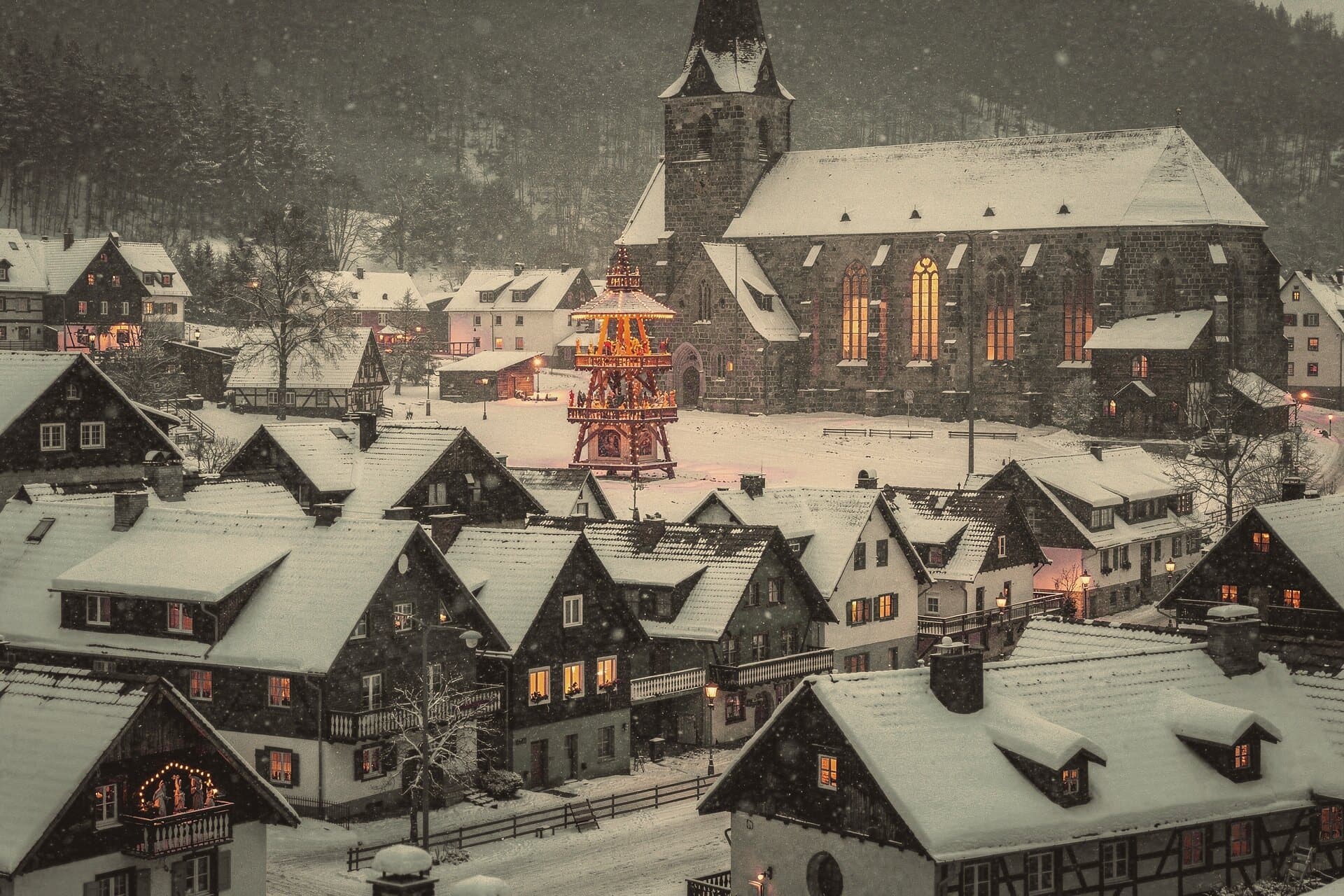
The Erzgebirge calls itself the Weihnachtsland, the Christmas land, and has done so since at least the 1950s. Its season traditionally opens when the great pyramids are set turning on the eve of the first Advent and lasts until Candlemas, the second of February.
Miners shaped many of these customs, as folklorists noted long ago, and some are far younger than they look: the giant town pyramids date from the 1930s, the candle arch in every window from the 20th century. This calendar follows them through the season, in the order they come.
The customs of Advent, in order
 Late November
Weihnachtsmarkt
Christmas markets: they open in the days before the first Advent. Freiberg’s Christmarkt, its more than ninety huts dressed in the miners’ tradition since 2012, opens on the Tuesday; Annaberg-Buchholz’s on the Friday, and it runs until December 23. Down in Dresden, outside the mountains, the Striezelmarkt, first recorded in 1434 and one of Germany’s oldest Christmas markets, has sold Erzgebirge toys since around 1700.
 The eve of the first Advent
Pyramidenanschieben
Setting the pyramids turning: on the Friday evening or Saturday before the first Advent Sunday, towns and villages gather around their great outdoor pyramids to start them for the season, often to a miners’ brass band. The first of these giant town pyramids turned in Frohnau, today part of Annaberg-Buchholz, in December 1933; by 2014 the Erzgebirge district counted about 150. In Schwarzenberg the pyramid keeps turning until Epiphany.
 From the first Advent
Schwibbogen
Candle arches in the windows: arches, angels and miners go up behind the glass, until, in the words of Saxony’s own campaign, there is “hardly a window without a Schwibbogen.” The custom has old roots in the mines: at the Himmelsfürst mine near Freiberg, every window of the mine buildings once held twelve candles in the early morning of December 24, bought by the miners themselves. The arch in every household window spread in the 20th century. That the lights guided the miners home is a tradition, and a beautiful one.
 Winter evenings
Hutzenabend
Neighbors’ evenings, from the old local phrase hutzen gehen, to go visiting the neighbors. On winter evenings families gathered in one house to save fuel, “Hutzen statt heizen,” huddle instead of heat: the women at their lace pillows, the men joining after the shift with talk, stories and songs. Central heating and television nearly ended it; today towns and inns hold Hutzen evenings again.
 Advent weekends
Bergparaden
Miners’ parades: some fifteen to twenty march through Saxony each Advent, in black parade dress, with lamps and miners’ bands. Freiberg’s torchlight parade falls on the Saturday before the second Advent; Schneeberg’s Lichtelfest, its festival of lights, on the second Advent weekend; and in 2025, after fourteen years, the great parade returned to Dresden on the Saturday before the fourth. The season closes in Annaberg-Buchholz on the fourth Advent Sunday, when more than a thousand marchers fill the town and the miners’ bands play together before St. Annen. The parades have been on Germany’s national inventory of intangible cultural heritage since 2016.
- Through Advent
Weihnachtsberg
Christmas mountain: a nativity built as a landscape in a corner of the room, of moss and tree roots edged with crystals, with Bethlehem beside a working model mine, its figures often moved by clockwork. Miners built them; disabled miners once carried mechanical mine models from town to town in boxes on their backs and showed them for coins. The custom flourished in the 19th century, and the finest examples now stand in museums.
 Before Christmas
Mettenschicht
The last shift: the miners’ final shift before Christmas. At the Himmelsfürst mine it began at four in the morning on December 24: the foreman read the Christmas devotion, an organ played in the mine house, and underground the men set candles on every ledge of rock. They worked only until the main break, then sat together, ate, told stories, sang carols and went up early. Mining clubs still hold Mettenschichten in old mines through Advent.
 December 24
Neunerlei
Nine kinds: on Christmas Eve the family sits down to a supper of nine dishes, already sung about in 1799. Every family’s nine are a little different, but the wishes behind them are the same: lentils or millet for small change (“as many grains, so many thalers”), dumplings for big money, sauerkraut so the year won’t turn sour, sausage or roast for strength. Bread and salt stand on the table, and in some villages no one may get up until the meal is done.
- December 24, December 31, January 5
Drei Heilige Abende
Three holy evenings: in the Erzgebirge, Christmas Eve, New Year’s Eve and the eve of Epiphany are all Heilige Abende. In 1665 Schneeberg’s miners went to the town council so that bakers from outside could keep selling them cheap butter Stollen on all three.
- Christmas morning
Christmette
Christmas morning service: it was held very early on Christmas Day, often at five, and in places still is. In 1880 the miners of Schneeberg won back the right to march to it with their lit mine lamps and set them in hollows cut in the stone of the church gallery. Schneeberg still opens Christmas morning at four with singing from its church tower.
- February 2
Mariä Lichtmess
Candlemas: the feast closes the season. In many houses this is when the pyramid stops turning, the arches come out of the windows and the pieces go back into their boxes until next Advent.
Bringing it home
You don’t need a mining town to keep these customs. Set your pyramid turning on the eve of the first Advent, and let it turn until Epiphany. Put a candle arch, or an angel and a miner, in the window for Advent, and leave them until Candlemas.
Ask the neighbors over on a dark evening for a Hutzenabend: one warm room, something for the hands, stories and Stollen. On Christmas Eve, try a small Neunerlei: lentils, potato dumplings, sauerkraut, sausage, stewed fruit, and bread and salt on the table. Light a smoker on a cold night, and in a corner of the room build a little Christmas mountain of moss, roots and stones around the nativity.
Candles and incense cones need watching. Our use and care page has the practical side: sizes, lighting and fire safety.
Sources
- Siegfried Sieber, “Bergmännische Weihnachtsbräuche im Erzgebirge,” Der Anschnitt 11 (1959)
- Siegfried Sieber, “Weihnachtsberge und mechanische Bergwerke,” Der Anschnitt (1952)
- Tourismusverband Erzgebirge, “Weihnachtsland Erzgebirge feiert Welterbe” (2019)
- Tourismus Marketing Gesellschaft Sachsen, Hintergrundtext Sachsens Weihnachtstraditionen (2025)
- Free State of Saxony, “So geht sächsisch”: Hutzenabend
- German Commission for UNESCO, Bergparaden und Bergaufzüge in Sachsen
- City of Freiberg, Freiberg Christmas market
- City of Dresden, Striezelmarkt history
- evangelisch.de, closing parade reports (2022, 2024)
- Duden, Hutzenabend