From Ore to Wood
Long before the last mine closed, the mining villages had found another living. As tin and silver faltered, families who had worked the rock took up the lathe, and the forests around them became the mountains’ new ore.
This chapter follows that change, from the first turners recorded in Seiffen in 1650 to the small workshops of today, and tells how, one by one, the Christmas pieces were born.
Out of necessity
Seiffen was a tin village. Its name comes from the Seifen, the stream gravels where tin was washed. The first turners appear in its records in 1650. They made spindles, plates and bowls, buttons, and little turned cases for needles and feathers; toys, it seems, at first only for their own children.
Tin mining boomed and failed and boomed again, and in Seiffen “miner or turner” became a question of survival. Turning began as a second job. During the 18th century it became the village’s main trade, apparently because it soon paid better than the mine, and many who left mining never went back. The Seiffen toy museum is plain about the motive: the picture of miners carving for pleasure after work fits the silver towns of the western Erzgebirge, but the Seiffen tin miner “was forced by economic hardship” to make a trade of the material that grew around him, wood.
It was work for the whole family. Miners’ wives spun flax on the side; children helped when orders pressed; a goat, “the miner’s cow,” and a small field kept the household fed. In the evening the light was poor: a burning pine splint or a rapeseed-oil lamp, so dim that even spinning could only be done by day.
Water and the lathe
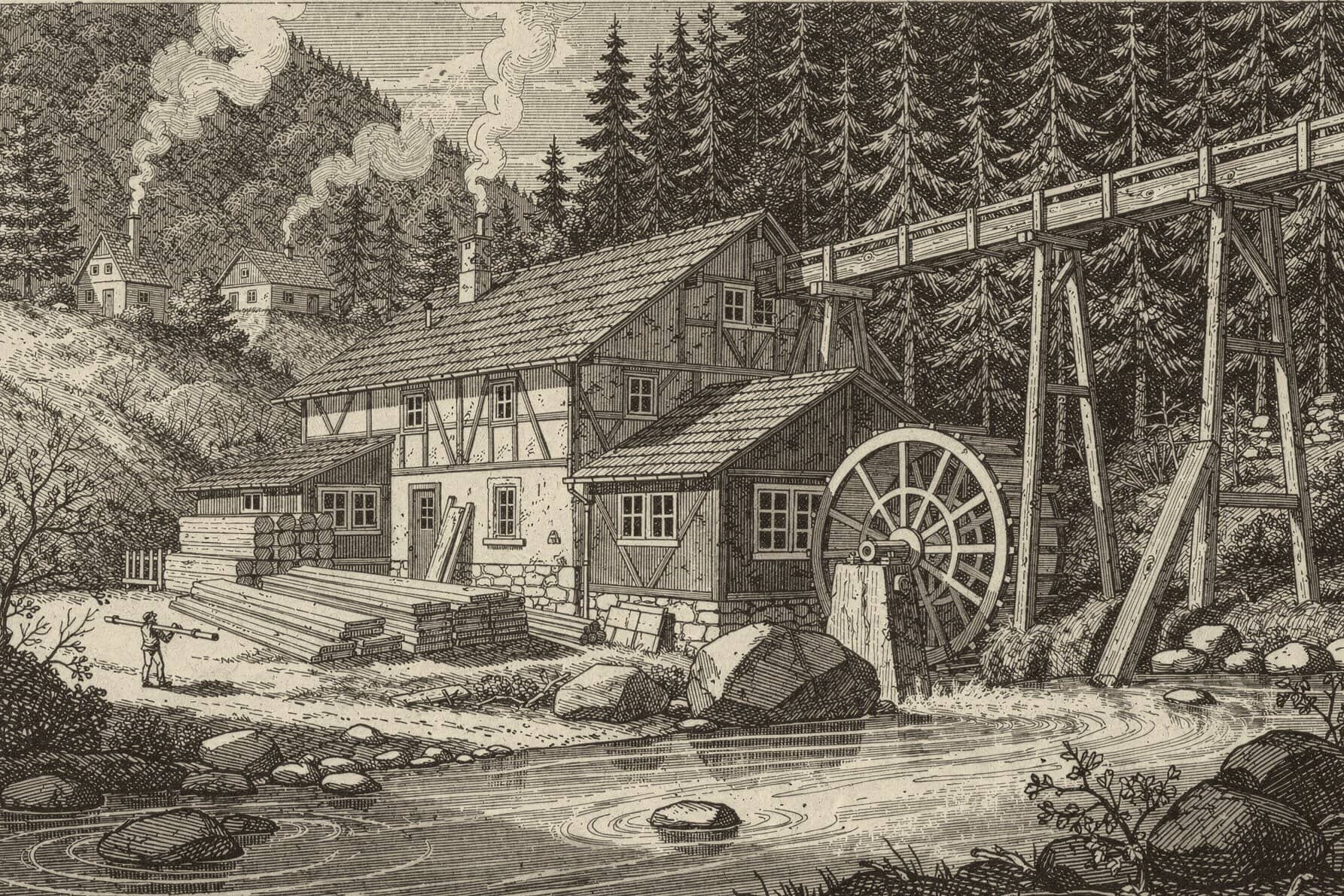
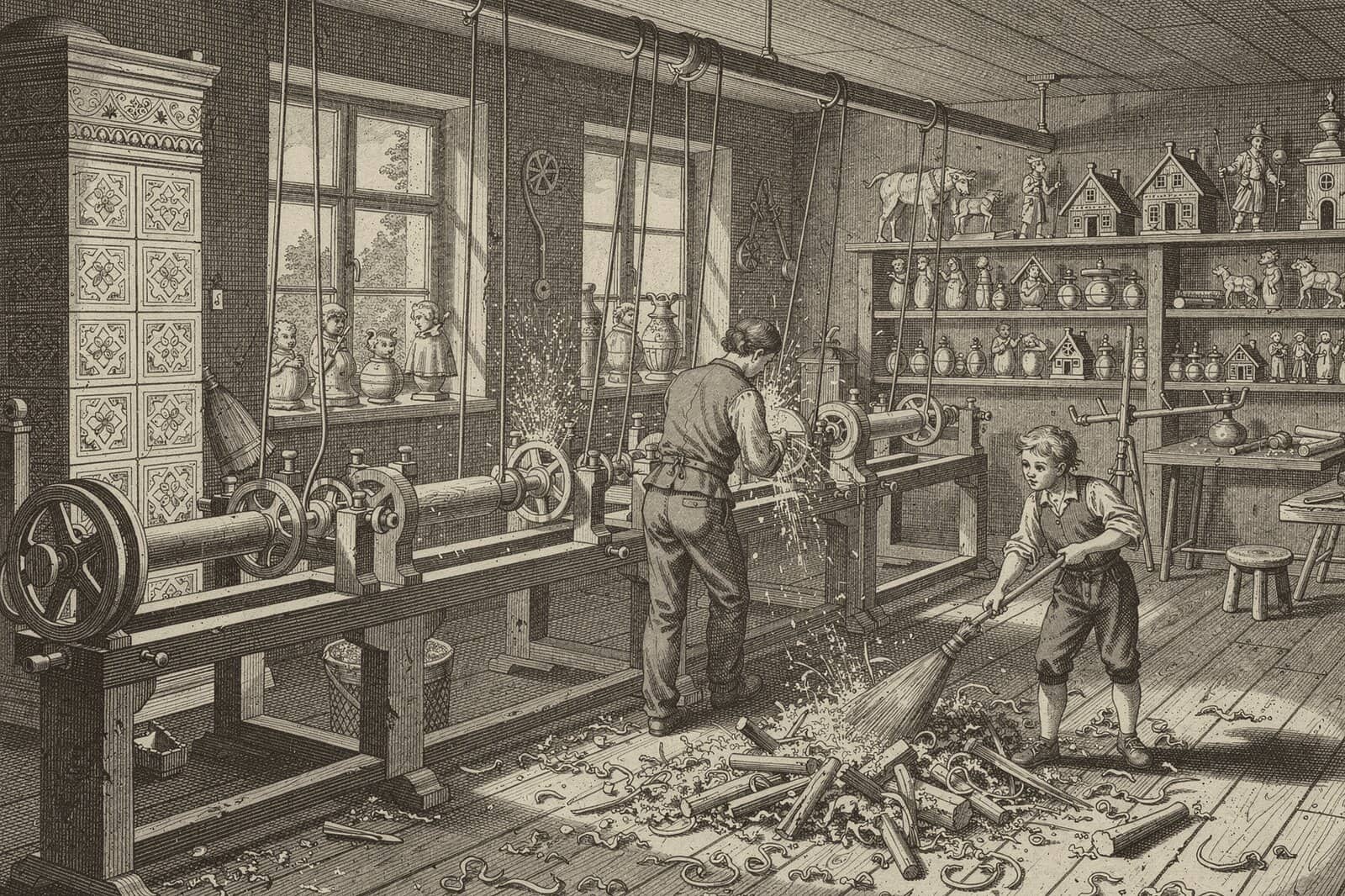
The mountain streams did the heavy work. Lathes were driven by water wheels, often in old ore-stamping mills, and by the middle of the 19th century more than twenty water-powered turning mills stood along the Seiffen valley. In 1869 the Erzgebirge counted 34 turning mills with 410 lathe positions and 624 turners.
One survives. Built in 1758–1760, the Seiffen mill turned three ring-turning lathes and four ordinary lathes from a wooden water wheel 5.2 meters (about 17 feet) across. Turners rented a place at its benches and had to bring their own wood, tools and lamp oil. In a hard frost the wheel froze and all work stopped.
Around 1800 the turners of Seiffen hit on a technique found nowhere else: Reifendrehen, ring turning, which yields dozens of identical animals from a single turned ring of spruce. It made cheap toy animals possible and, the toy museum says, helped make Erzgebirge wooden toys competitive around the world.
Peddlers, merchants and the wide world
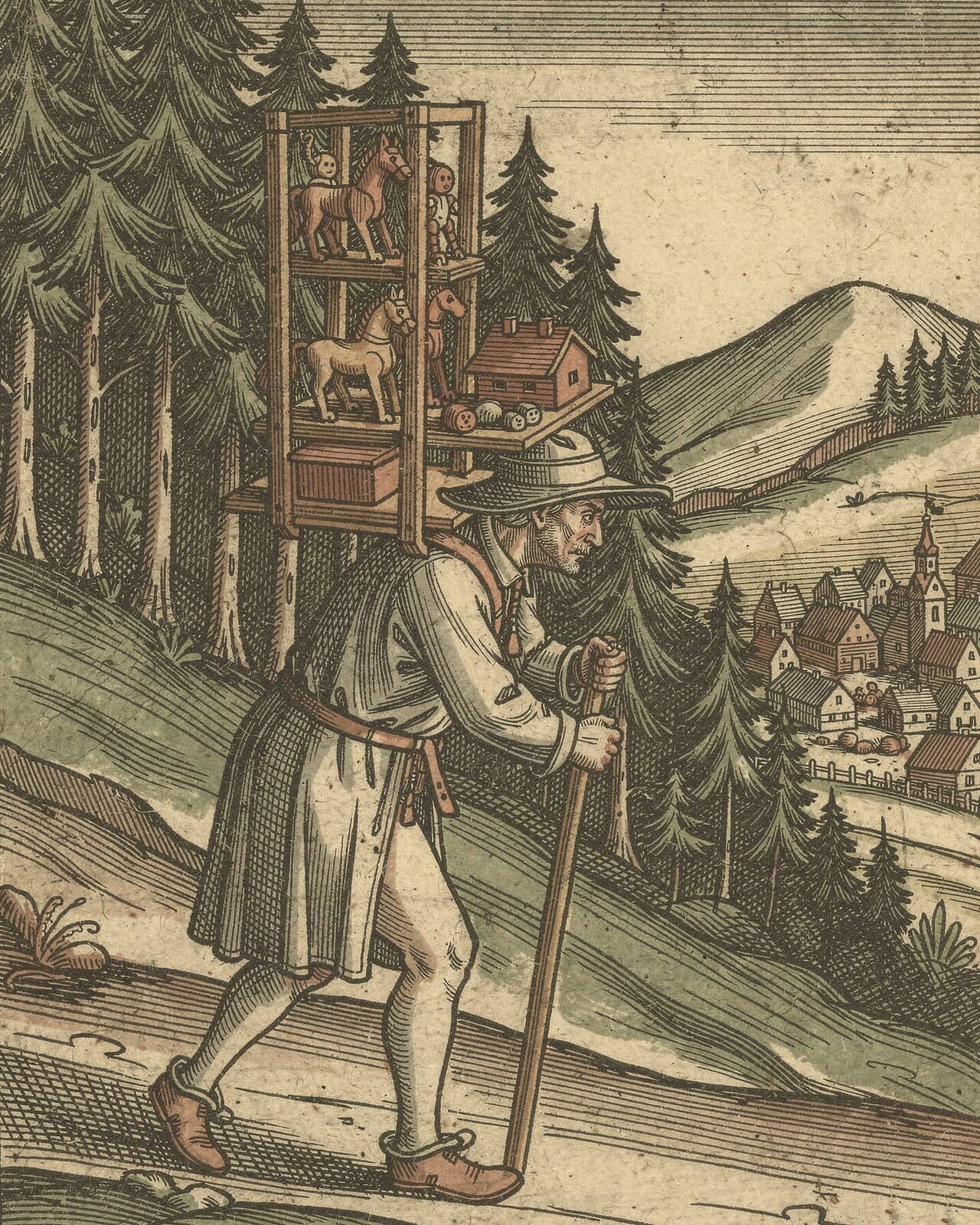
At first the toys left the mountains on the backs of peddlers, in baskets, sacks and trays or on handcarts. By local tradition, in 1699 a linen trader named Johann Friedrich Hiemann pushed a wheelbarrow of Seiffen turned goods to the Leipzig fair and came home with orders.
Then the Verleger, the merchant-publishers, took over. They traveled for orders, brought the turners models, wood and paint, and paid them weekly on delivery, sometimes in goods from their own shops rather than in cash. In 1804 the leading Seiffen merchant house was said to pay out about 1,000 thalers a week. Much of the work went out anonymously as Nürnberger Tand, “Nuremberg trinkets,” copied to order from Nuremberg samples. Overseas trade began in 1784; an account of 1804 already names “America” among the main markets, and the boxed Noah’s ark became an export hit.
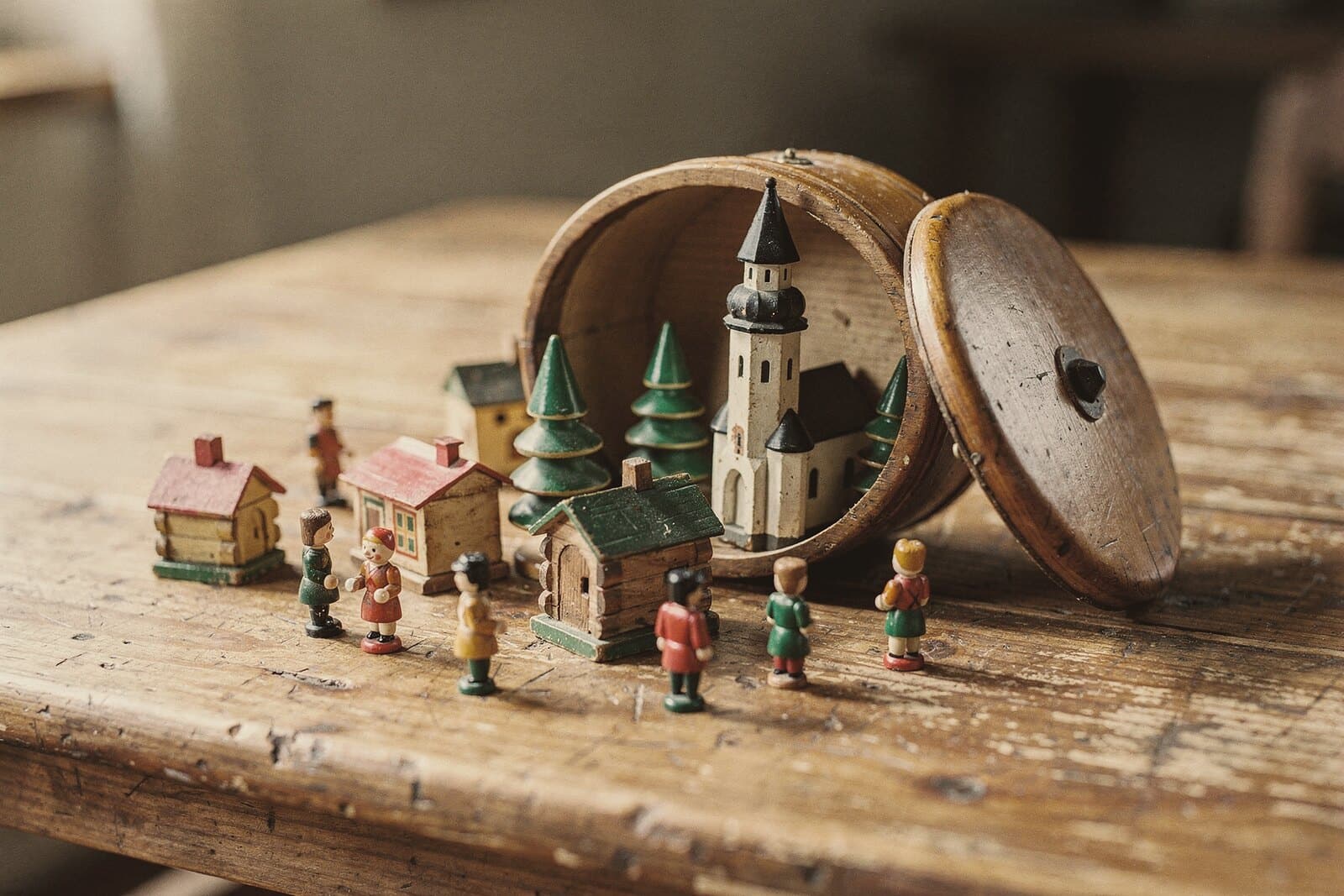
It was not an easy living. In 1843, 158 turners and toymakers petitioned their lord about their misery: a man who had to compete with cut-price goods, they wrote, would starve along with his family. In 1852 the Saxon state opened a toy-making school in Seiffen. When foreign tariffs hit heavy goods at the end of the century, Seiffen turned to the very small: whole toy villages packed in a matchbox. On the eve of the First World War some 50 towns and villages in the Erzgebirge made toys, in more than 1,100 businesses.
The Christmas pieces, one by one
The Christmas pieces came late in this story, and not all at once. Here is when each first appears in the record; their full stories are in the catalogue.
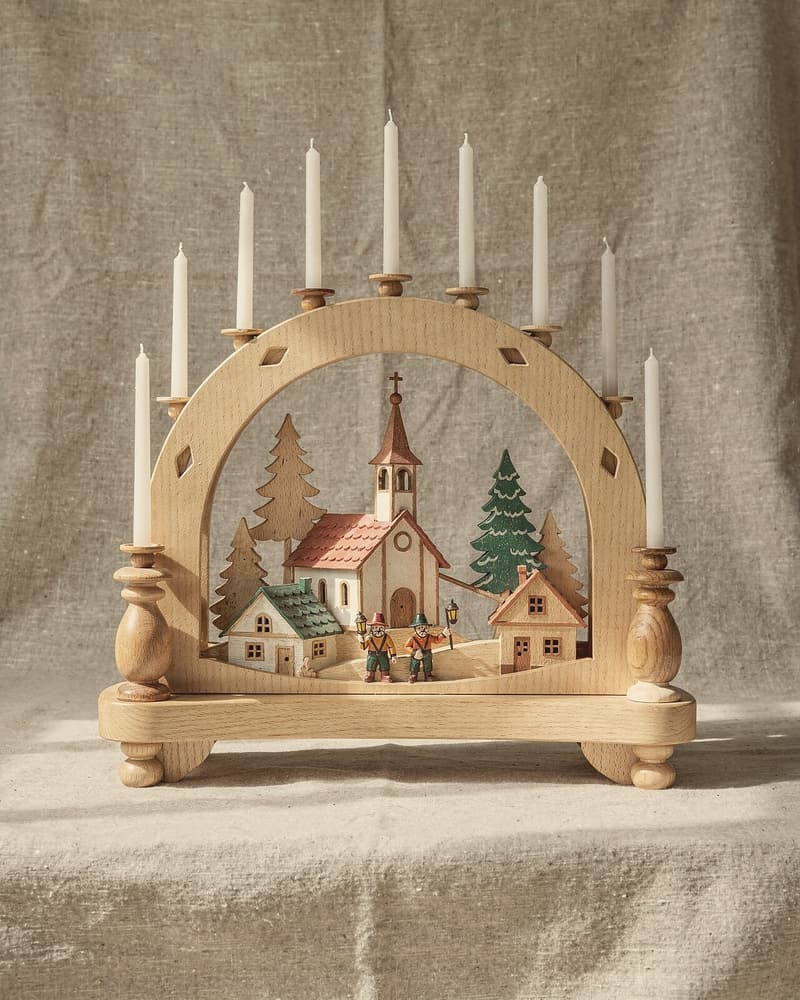 1740
1740The candle arch
The oldest known candle arch, forged in iron by a mine blacksmith in Johanngeorgenstadt, bears the date 1740.
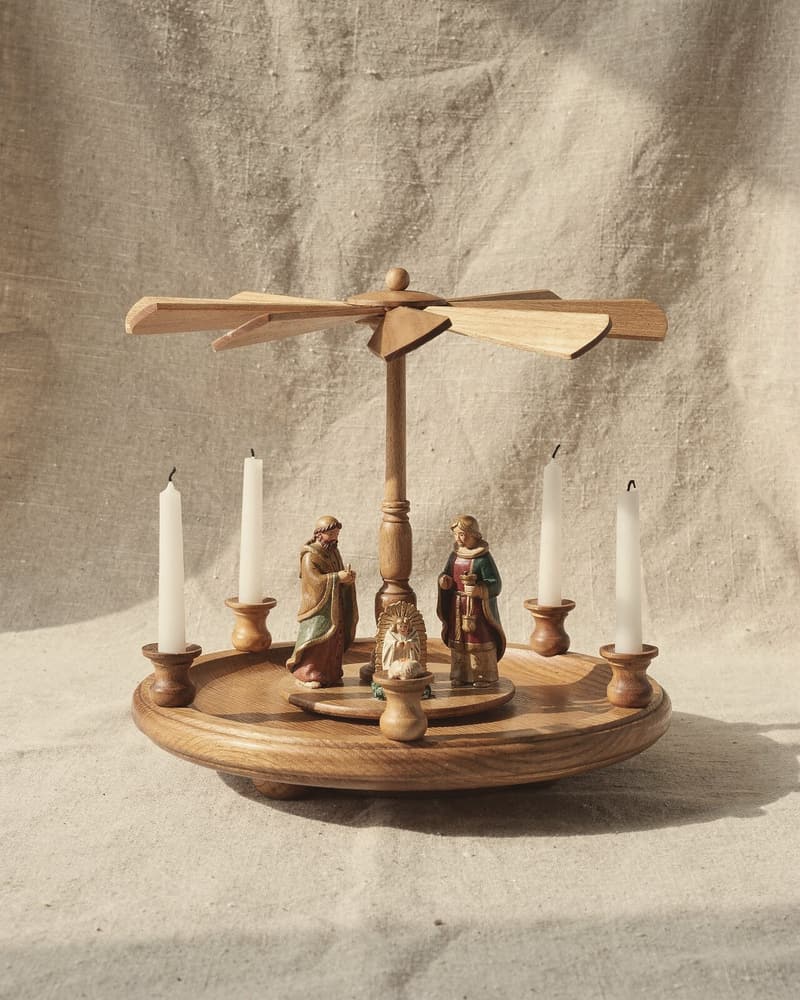 Around 1800
The Christmas pyramid
The turning pyramid appears around 1800; the oldest to survive, from about 1810, has a miners’ parade on its lowest tier.
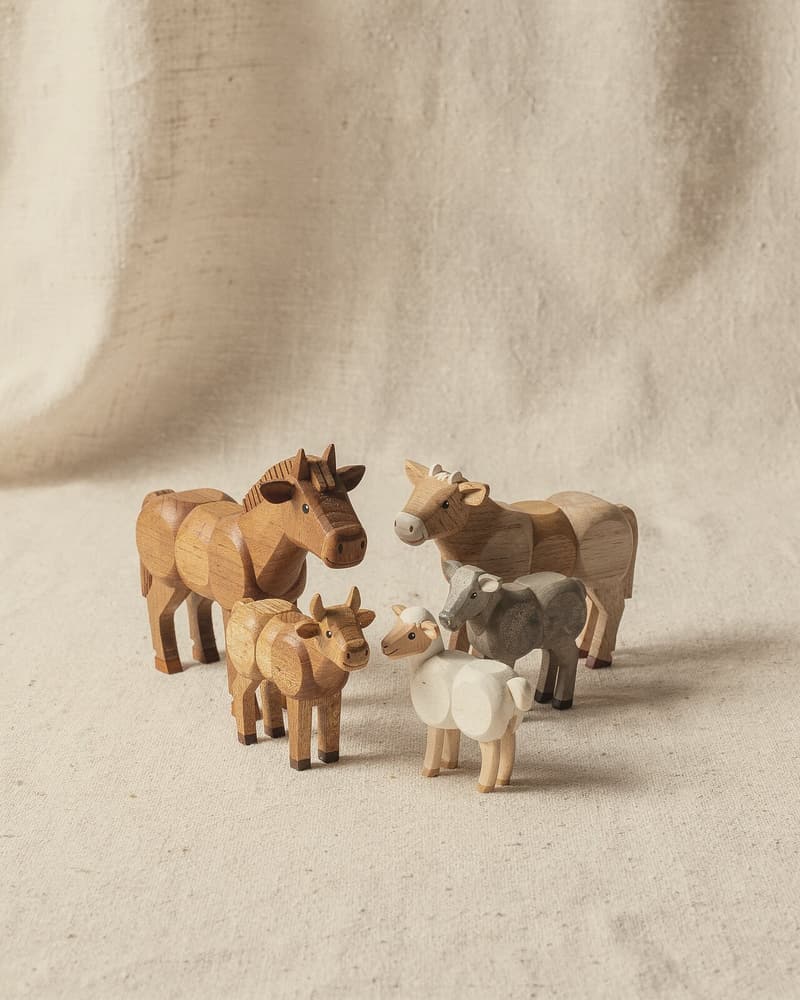 Around 1800
Ring-turned animals
Seiffen’s turners learn to hide an animal’s profile in a turned ring of spruce, then split it into dozens of identical blanks.
 The 1830s
Angel and miner
Miner figures had held candles on church altars since the 1670s; the household pair of candle angel and candle miner appears in the 1830s.
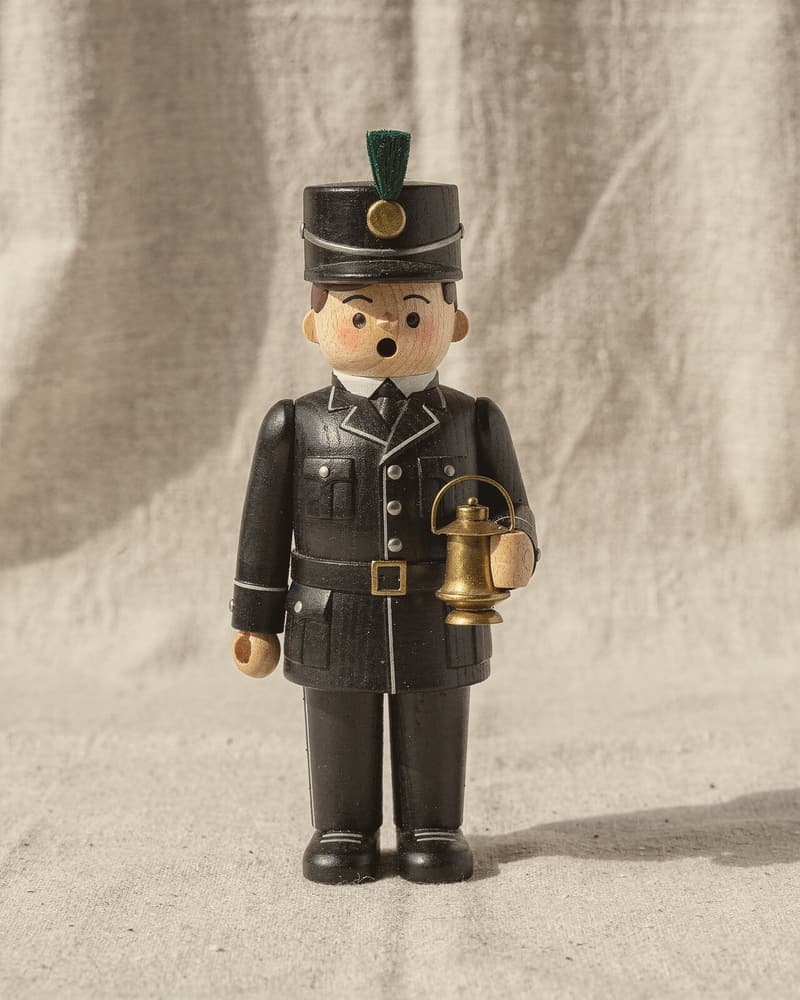 Around 1850
The smoker
The first wooden smokers are credited to a woodturner in Heidelberg, a village next to Seiffen, around 1850.
 Around 1850
The shaved tree
Pattern books of about 1850 show little trees curled from a single piece of wood; Seiffen’s toy school revived the craft around 1920.
 Around 1870
The nutcracker
Around 1870 the Seiffen turner Wilhelm Friedrich Füchtner begins turning nutcrackers in the shape of soldiers, miners and policemen.
Christmas carries the village
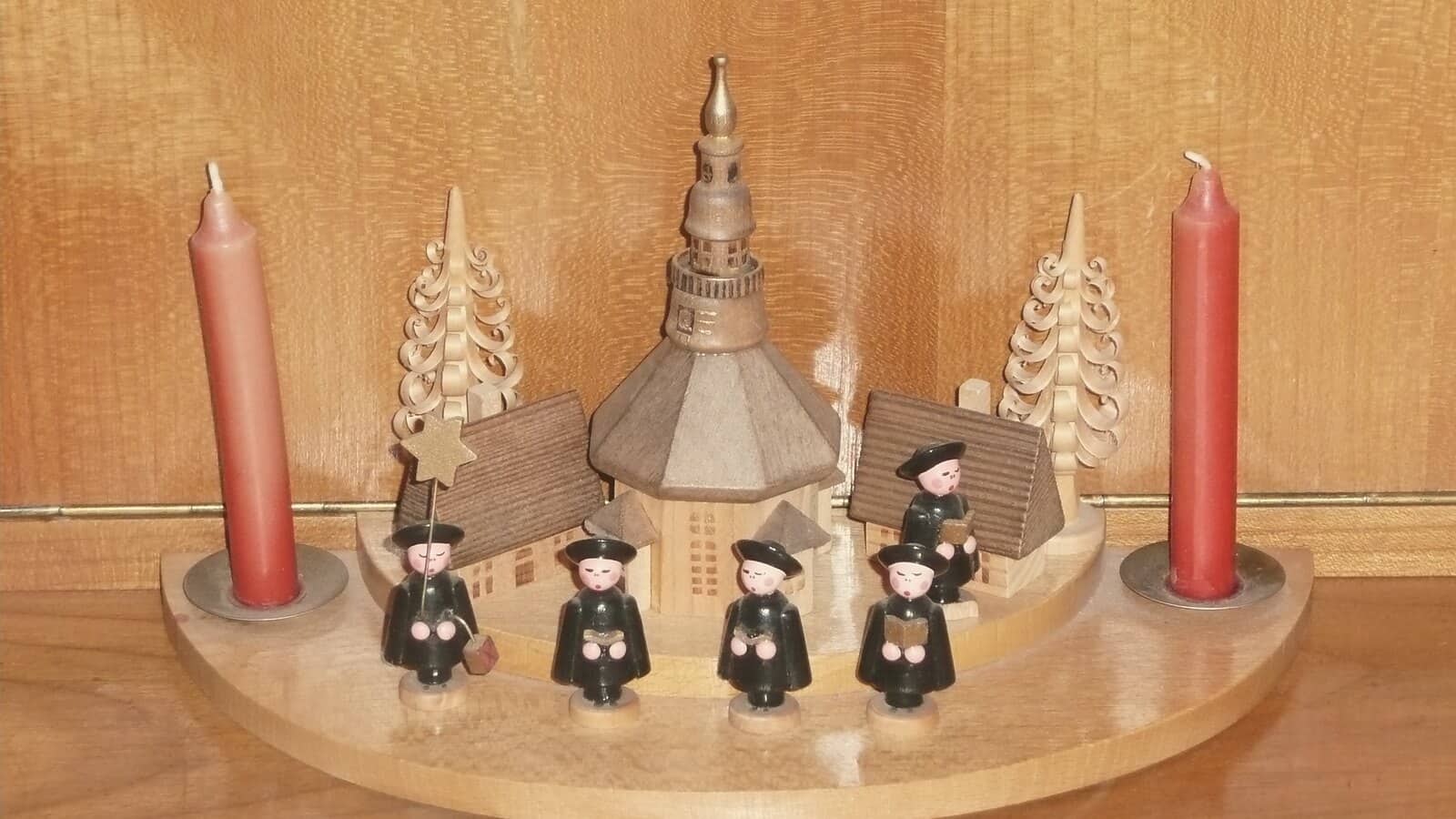
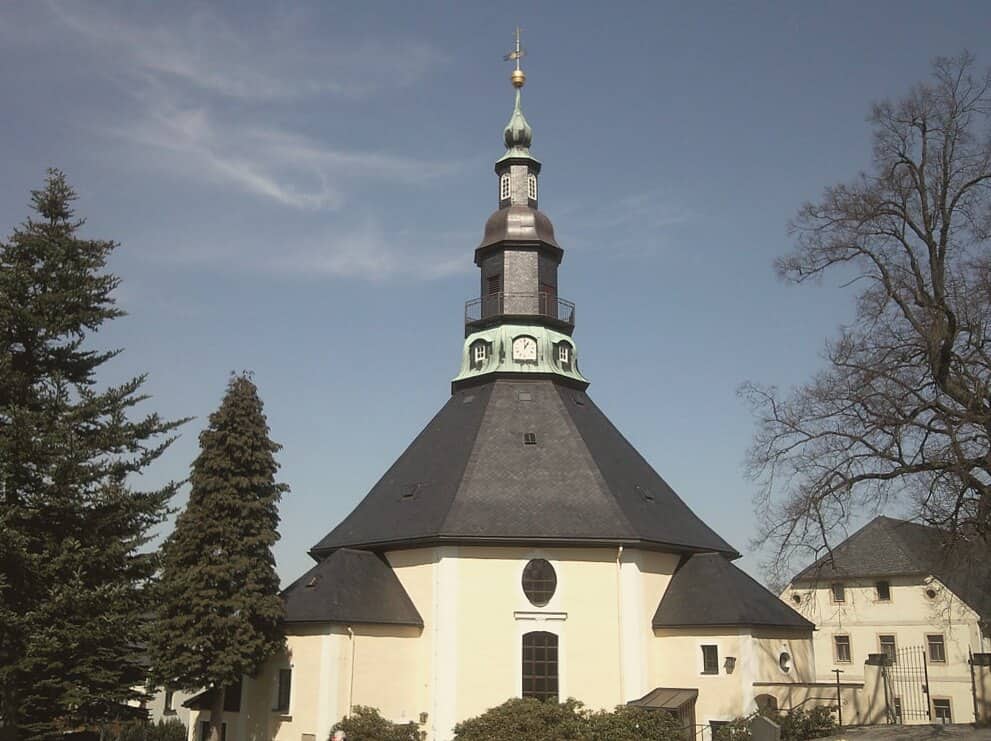
In the 20th century, Christmas kept the woodturning villages alive. At Christmas 1914 the director of the Seiffen toy school saw only a few lanterns carried to the early Christmas service, and had his pupils design bright patterns for them; the next year more than a hundred went to church. In 1915 his school also built a miniature scene of children with lanterns streaming out of the lit village church after the Christmas service. It still stands in the toy museum.
Crisis years
The 1920s and 1930s brought crisis. In the world depression after 1929, unemployment in the toy district reached 60 percent. Seiffen, its school director wrote in 1935, had come through better than other toy regions because it had taken up artistic Christmas and gift articles. The first series of commercially made pyramids in Seiffen dates from 1923; the first giant outdoor town pyramids went up in 1933–34; and in 1937 the Leipzig artist Paula Jordan designed the candle arch that became the best known of all, two miners between a woodcarver and a lace-maker, for a Christmas exhibition in Schwarzenberg.
These were also the years of the Nazi regime, which promoted the Erzgebirge as Saxony’s model “Christmas land.” Several of the region’s best-known forms took their classic shape then, which is a reminder that these traditions were never fixed; they have always been changing.
Under the GDR
After 1945, in what became East Germany, the industry was reorganized step by step. Some firms were expropriated in 1946; independent craftsmen were grouped into production cooperatives in the 1950s; and in 1972 the last private and semi-private firms were turned into “people’s enterprises.” A state toy combine based in Olbernhau absorbed many small workshops; in 1981 it had about 3,600 employees at 96 sites. Machines took over more of the work, though a nutcracker still took “over a hundred work steps.”
Much of what the workshops made went abroad. Smokers were so much in demand in West Germany, Italy and Austria that many were exported, and at home a candle arch was, like so much else, hard to get. Many families sawed their own with a fretsaw.
The workshops today
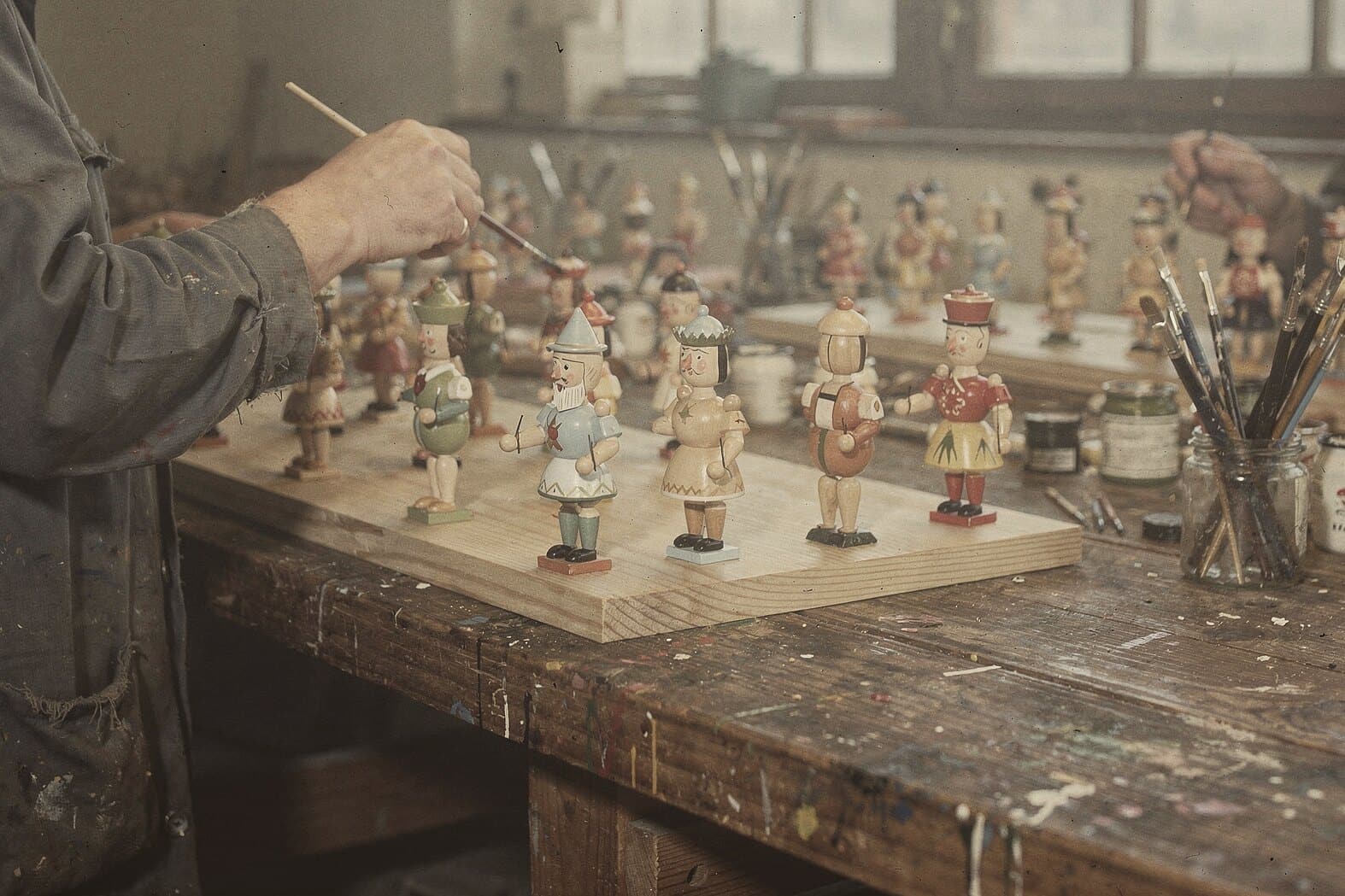
After 1990 the state structures collapsed; firms were returned to private hands and new workshops were founded. The makers’ trade association counts some 30,000 different products today, more than two-thirds of them designed since 1990.
In 2022 Saxony counted 424 woodcraft businesses on its register of crafts, 244 of them in the Erzgebirge district, earning more than 50 million euros a year. About a fifth of the work is exported, and the most important market abroad is the United States and Canada. Most of the makers are small family businesses; the largest employ about a hundred people, the smallest just one.
The craft is still taught. A vocational school in Seiffen, reopened in 1995, is the only school in Germany that trains wooden-toy makers; some 15 to 20 apprentices finish its three-year course each year. In 2025 the Erzgebirge’s woodcraft was entered in Germany’s national register of intangible cultural heritage.

The wood era at a glance
- 1650
The first turners are recorded in Seiffen.
- 1699
By tradition, Seiffen turned goods reach the Leipzig fair on a wheelbarrow.
- 1740
The oldest known candle arch is forged in Johanngeorgenstadt.
- 1758–1760
The water-powered turning mill in Seiffen is built.
- 1784
Overseas trade in Seiffen toys begins.
- c. 1800
Ring turning develops around Seiffen; the turning Christmas pyramid appears.
- c. 1830
The candle angel and candle miner appear as a household pair.
- 1849
Seiffen’s mining office closes.
- c. 1850
The first wooden smokers, in Heidelberg near Seiffen.
- 1852
The state toy-making school opens in Seiffen.
- c. 1870
Wilhelm Friedrich Füchtner turns the first Seiffen nutcrackers.
- 1912
Electricity reaches Seiffen; motors begin to replace water wheels.
- 1933
The first giant outdoor town pyramid turns in Frohnau.
- 1937
Paula Jordan designs the best-known candle arch.
- 1972
The last private firms are nationalized in the GDR.
- 1990
Private workshops return after reunification.
- 2025
The craft enters Germany’s national register of intangible cultural heritage.
Sources
- Erzgebirgisches Spielzeugmuseum Seiffen, “Entstehung der erzgebirgischen Spielzeugherstellung” (2018)
- Erzgebirgisches Spielzeugmuseum Seiffen, chronicle
- Erzgebirgisches Spielzeugmuseum Seiffen, history of the Seiffen toy school
- Erzgebirgisches Spielzeugmuseum Seiffen, “Weihnacht im Museum”
- Kurort Seiffen, “Seiffener Verleger”
- Helmut Schwarz, “Spielzeug aus dem sächsischen Erzgebirge,” Spirit of Play (2017)
- Institut für Sächsische Geschichte und Volkskunde, Fundstück December 2020
- Karl Ewald Fritzsch, “Bergmann und Engel als weihnachtliche Lichterträger,” Der Anschnitt (1959)
- DDR Museum Berlin, “10 objects for a Christmas in the GDR” (2022)
- Saxon State Ministry for Economic Affairs, press release (August 17, 2022)
- German Commission for UNESCO, “Vernetzung und Weiterentwicklung des Kunsthandwerks im Erzgebirge”