The Bergparade: miners in their Sunday best
Every Advent, more than a thousand men and women in black parade dress march through Annaberg-Buchholz. How a royal wedding of 1719 dressed the Saxon miner, and how the parades survived to the present.
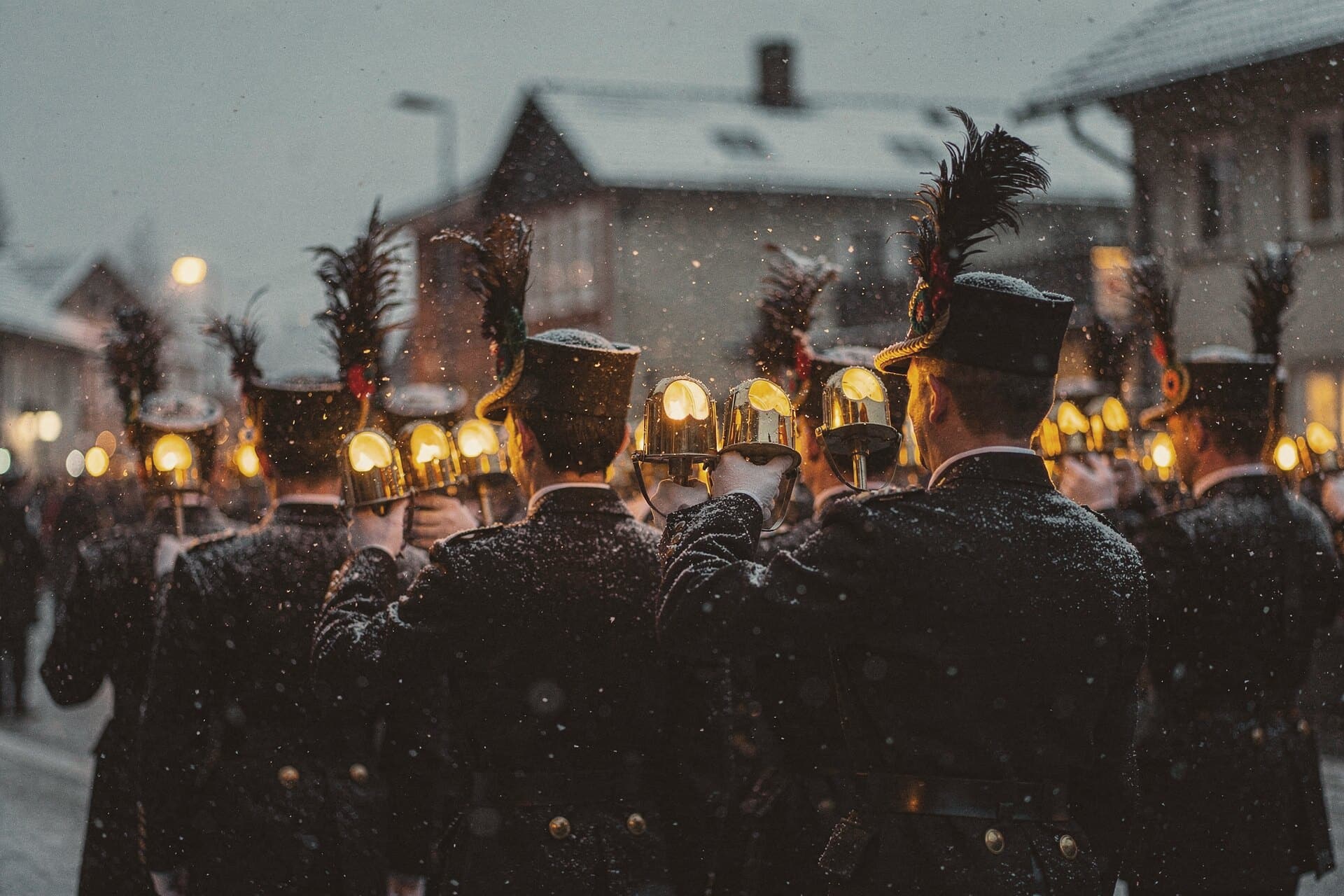
On the fourth Sunday of Advent the light goes early in Annaberg-Buchholz, and the town fills with miners. More than a thousand of them, from all over Saxony and from other mining regions of Germany, march through the old silver town in black jackets and tall green hats, carrying lamps and ceremonial axes, behind their miners’ bands. At the end, the bands gather before the great church of St. Annen and play together. It is the largest miners’ parade in the region and the last of the season. “Christmastime,” as Saxony’s culture minister put it, “is the time of the mining parades.”
The dress they wear goes back to a wedding.
A royal wedding, 1719
In September 1719 Augustus the Strong, Elector of Saxony and King of Poland, married his son to an Austrian archduchess and celebrated for a month. The climax came on September 26 in the Plauenscher Grund, a valley outside Dresden: the Saturnfest, the festival of Saturn, last of seven festivals named for the planets. Augustus had planned a peasants’ festival and turned it instead into a festival of Erzgebirge mining.
Some fifteen hundred miners and smelters marched by torchlight; the sources give anywhere from 1,400 to 1,600. A working furnace smelted silver as they went, and a press struck medals. The miners wore a newly regulated parade dress, the Habit, and a painter recorded the whole procession on a frieze 38 meters (126 feet) long with some six hundred figures, which the mining academy in Freiberg still keeps. At its head rides an official in mining dress and wig; behind him come mining boys with torches, trumpeters and kettledrummers, hewers carrying their lamps, foremen, and a mine master with the miners’ flag.
Reading the Habit
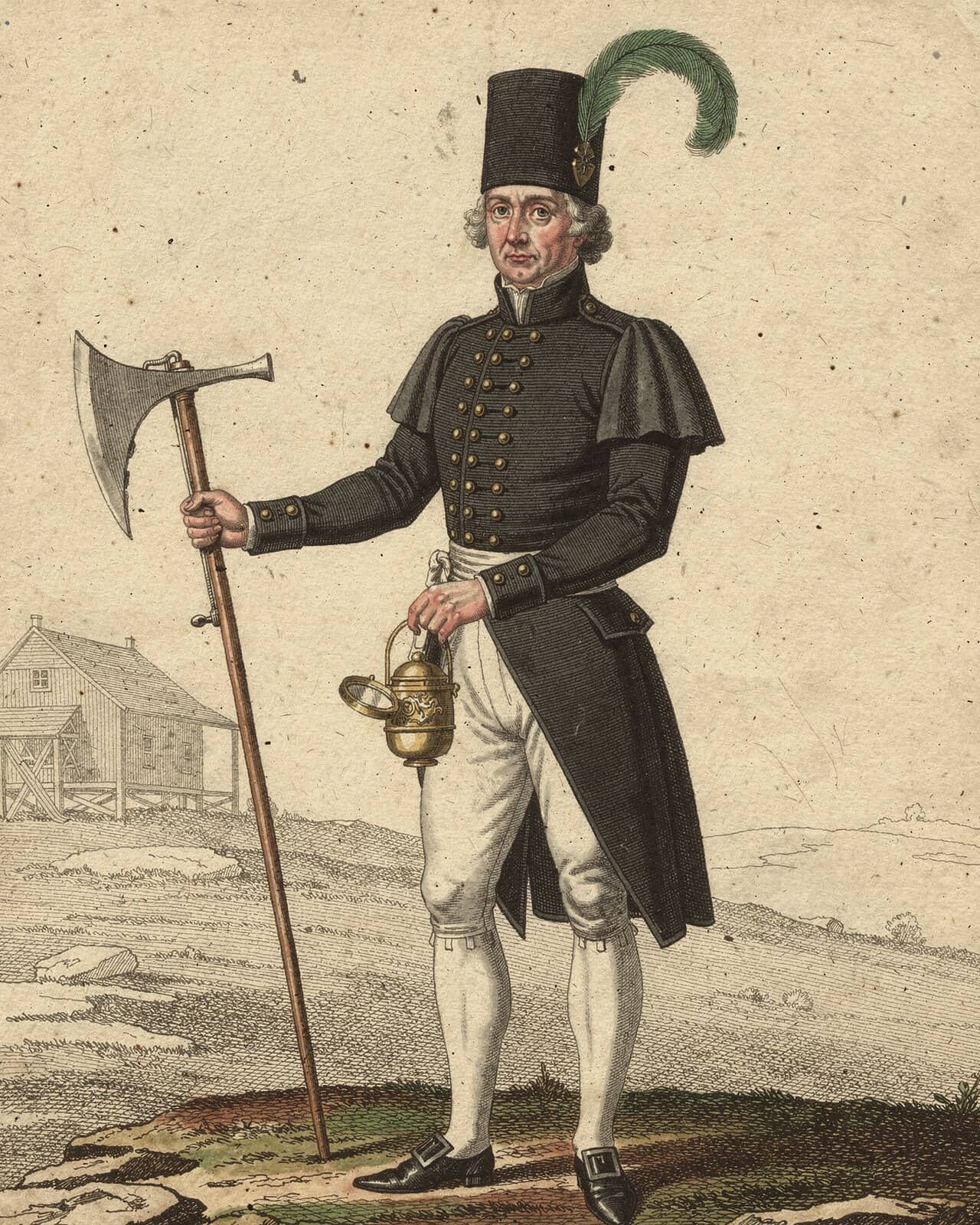
The dress was regulated again in 1768–69 and became a true uniform: ranks, district colors, rules for every button. Its basic cut was worn with few changes until Saxon silver mining ended in 1913, and the parades still follow it.
Read it from the top. The hewer, the miner who cut the ore, wears a round green shaft hat, about seven Saxon inches high. His black jacket is closed with gold buttons. Below it he wears white trousers and white stockings, and three marks of his standing: the Arschleder, the leather seat he once sat and slid on underground; the knee straps; and the Bergbarte, a ceremonial axe carried on the left shoulder, which the Freiberg miners say is known only in the Erzgebirge. He carries a lit lamp or a torch, because parades so often began late in the evening or early in the morning. The green-and-white cockade on his hat has been the Saxon colors since 1827.
The colors told you where a man came from. In 1831 a Freiberg publisher listed them: scarlet with gold for Freiberg and the mining offices, white with gold for Annaberg, straw yellow with gold for Marienberg, scarlet with silver for Schneeberg, carmine for Altenberg and Johanngeorgenstadt, blue with silver for the cobalt-blue works.
The smelter wears white, with a scarlet collar and a hat shaped like a shepherd’s, “the most visible difference,” the Freiberg miners say, from all other smelting workers. Officials wear nine grades of embroidery and stars, a plume black below and yellow above, and nine buttons stamped with the crossed hammer and chisel. The musicians are known by the “swallows’ nests” on their shoulders.
Who walks where
A parade has its order. In Freiberg today it opens with four hewers as torchbearers and the flags; then the chief mining officer, the elders with hammer and pick, the timbermen, the band with its bell tree and kettledrums, mounted officials, eight elders carrying ore troughs, the hewers with axes on their shoulders, the mine masons and smiths. The smelters follow in a block of their own, then the mining students, the blue-color workers, and four more torchbearers to close. Historic parades ran from a hundred marchers to more than three thousand, usually four abreast.
Christmastime is the time of the mining parades.
Barbara Klepsch, Saxon Minister for Culture and Tourism, 2022
Lean years
The war and the years after it brought the old traditions almost to a standstill. In the GDR the surviving miners’ brotherhoods were folded into the state’s cultural association, and one district guideline laid down that mining parades were “not to be combined with a miners’ church service or other sacred acts.” Some brotherhoods, their own journal recalls, got around the rule with cunning.
In 1986, for Freiberg’s 800th anniversary, still in GDR times, some 250 miners and smelters and 40 musicians marched in historical uniforms to the market square, and the Freiberg miners’ club was founded that spring. In October 1990, weeks after reunification, thirteen clubs founded the Saxon state association of miners’ and smelters’ societies. Today it has more than sixty member clubs and some three thousand members. Women and children march now too.
Back in the streets
In 2016 the miners’ parades and processions of Saxony were entered in Germany’s national inventory of intangible cultural heritage, and in 2023 the singing of the miners’ anthem, the Steigerlied, joined them. Most of the parades take place in Advent, some fifteen or twenty each season, and draw tens of thousands of visitors to the mining towns.
On December 20, 2025, the great parade came back to Dresden after fourteen years: more than five hundred musicians and marchers from twenty-nine clubs, a group from Měděnec on the Czech side of the mountains among them, walked from the Elbe past the Frauenkirche, in the city outside which, three centuries before, their predecessors had marched for a royal wedding.
Quotations from German sources are our own translations.
Sources
- Deutsches Bergbau-Museum Bochum, frieze of the 1719 Saturn festival procession (object records)
- G. E. Rost, Trachten der Berg- und Hüttenleute im Königreiche Sachsen (Freiberg, 1831), Wikisource
- Historische Freiberger Berg- und Hüttenknappschaft, the Bergparade
- Bergglöckchen 2/2010, journal of the Saxon miners’ state association
- German Commission for UNESCO, Bergparaden und Bergaufzüge in Sachsen
- Saxon State Ministry for Culture and Tourism, press release, December 16, 2022
- evangelisch.de, closing parade in Annaberg-Buchholz, December 22, 2024
- City of Dresden, Striezelmarkt: the Bergparade
More stories
Why the miners longed for light
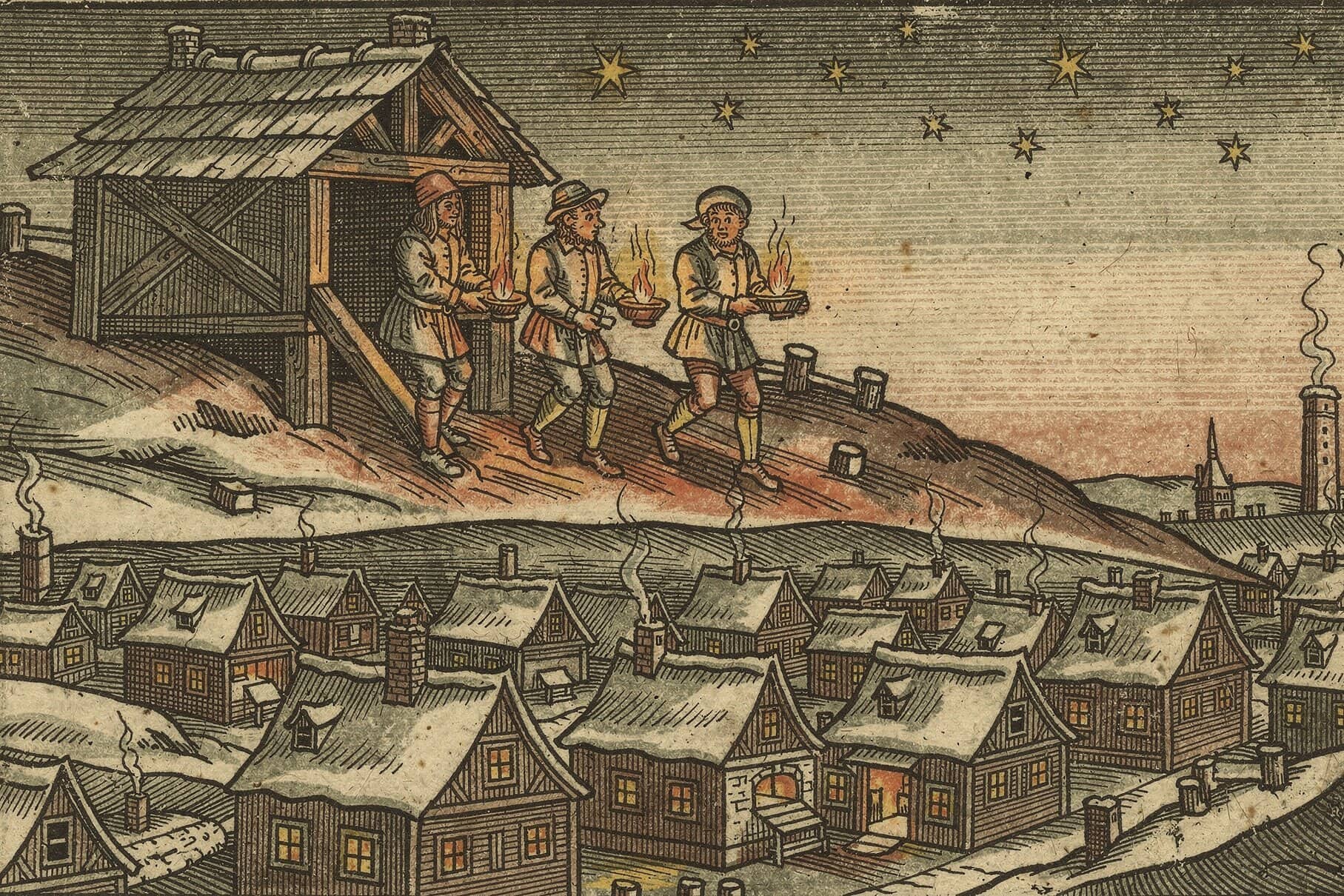
In midwinter, many Erzgebirge miners went down before dawn and came up after dark. What the record says about their light, and the story the mountains tell about it.
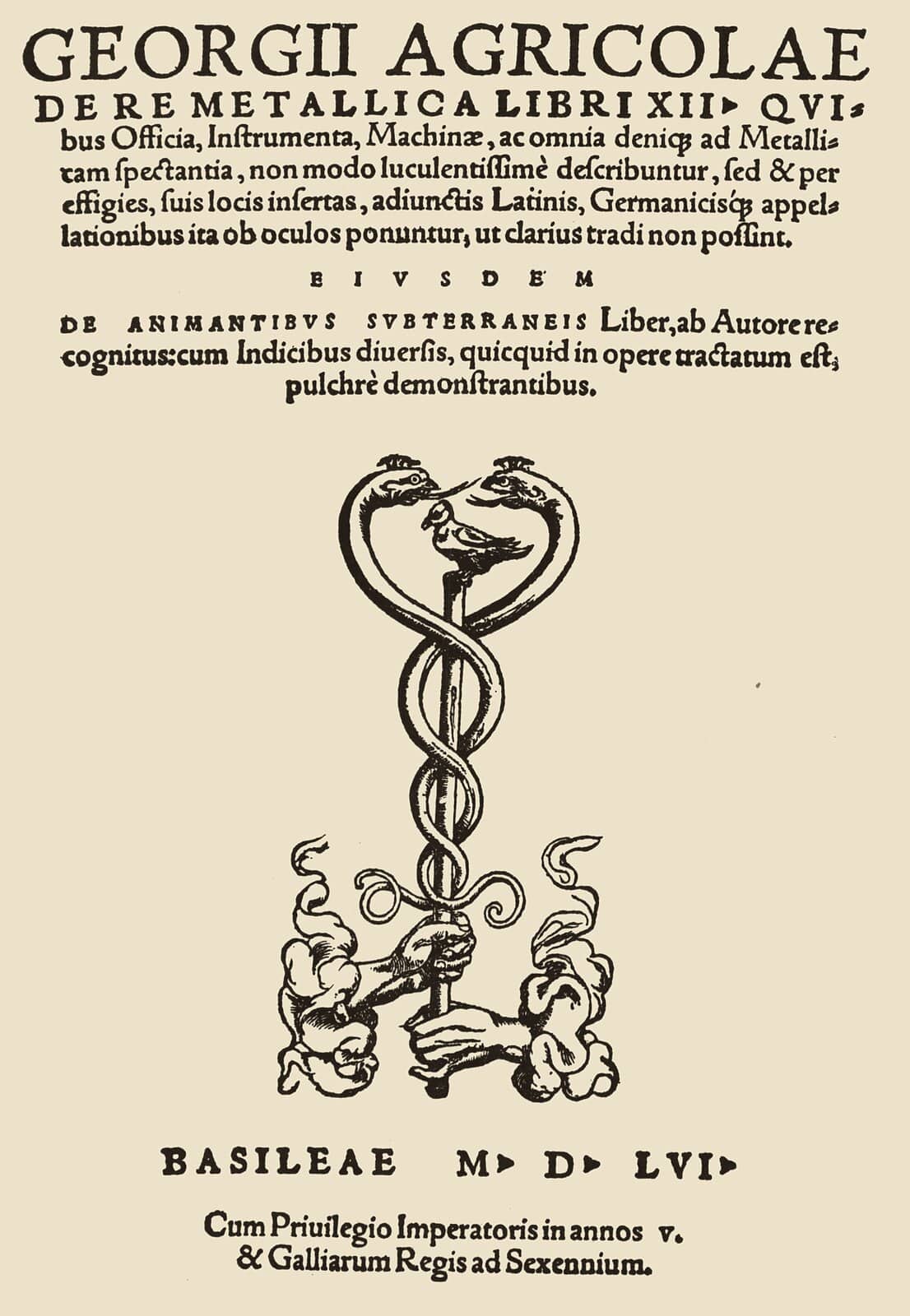
Title page of Georgius Agricola, De re metallica (Basel: Froben, 1556), public domain; scan: Mining Heritage, via Wikimedia Commons Agricola’s Book of Mines
A town doctor in a silver boomtown spent twenty-five years on the great book of mining. It was printed after his death, refused a grave in his own city, and translated into English by a future American president.
How the nutcracker came to America
A carved nut-biter from the German mountains, a king from Seiffen, a ballet that bored its first audience, and a Christmas Eve in San Francisco. How the nutcracker became an American Christmas.