Die Weihnachtspyramide: Christmas Pyramids
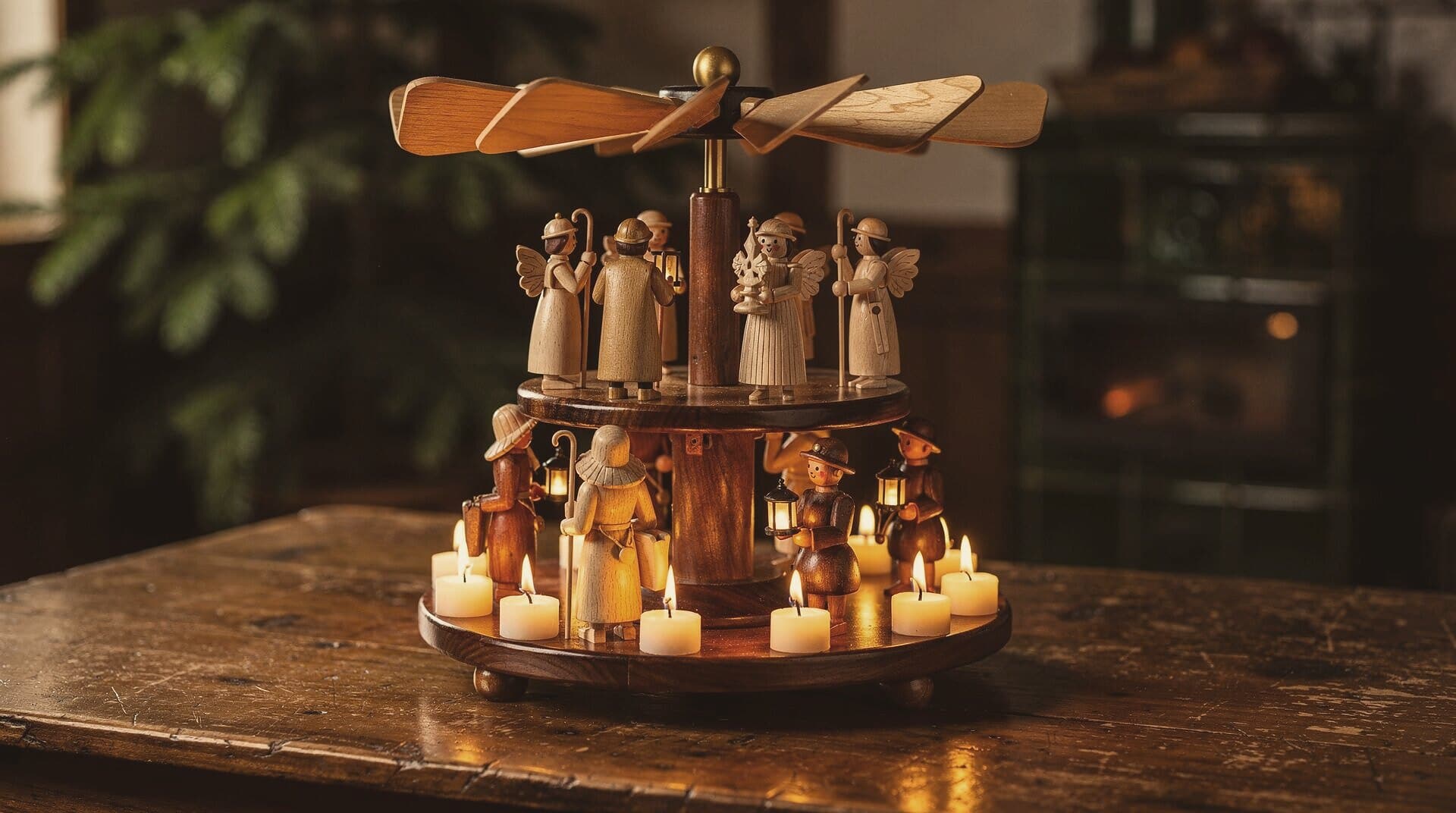
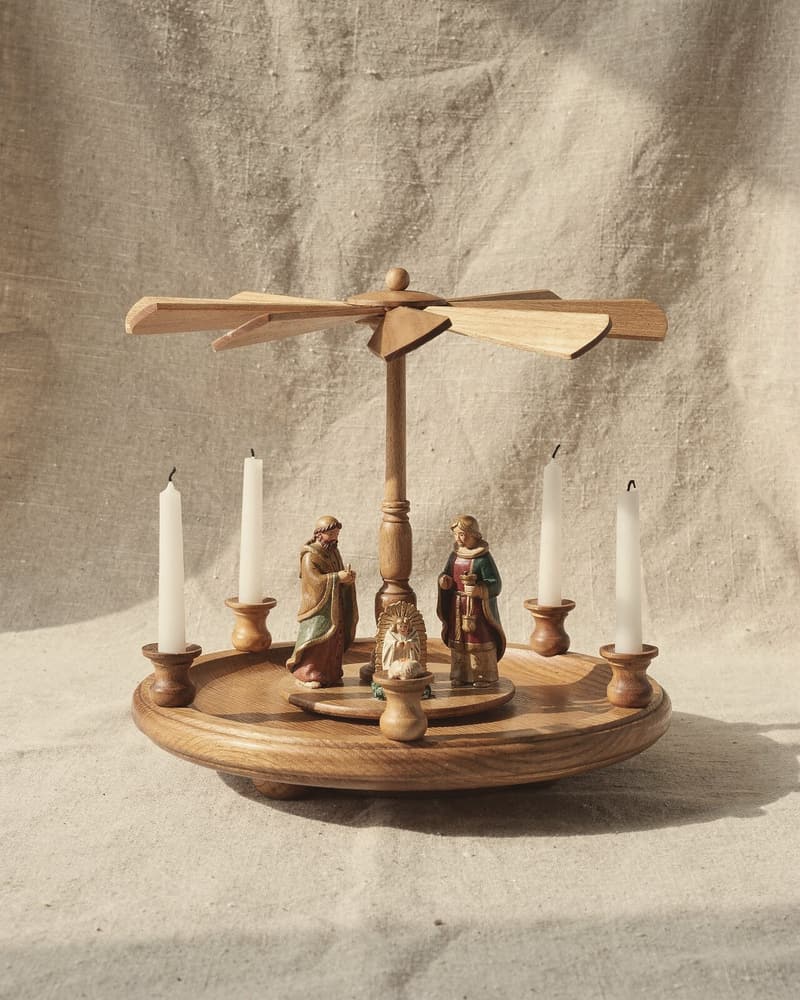
Tiers of figures on turning plates, and above them a wheel of wooden blades turned by nothing but the warmth of the candles. The turning pyramid appeared in the Erzgebirge around 1800. Today it stands on parlor tables, and its giant cousins turn in the town squares all through Advent.
Styles
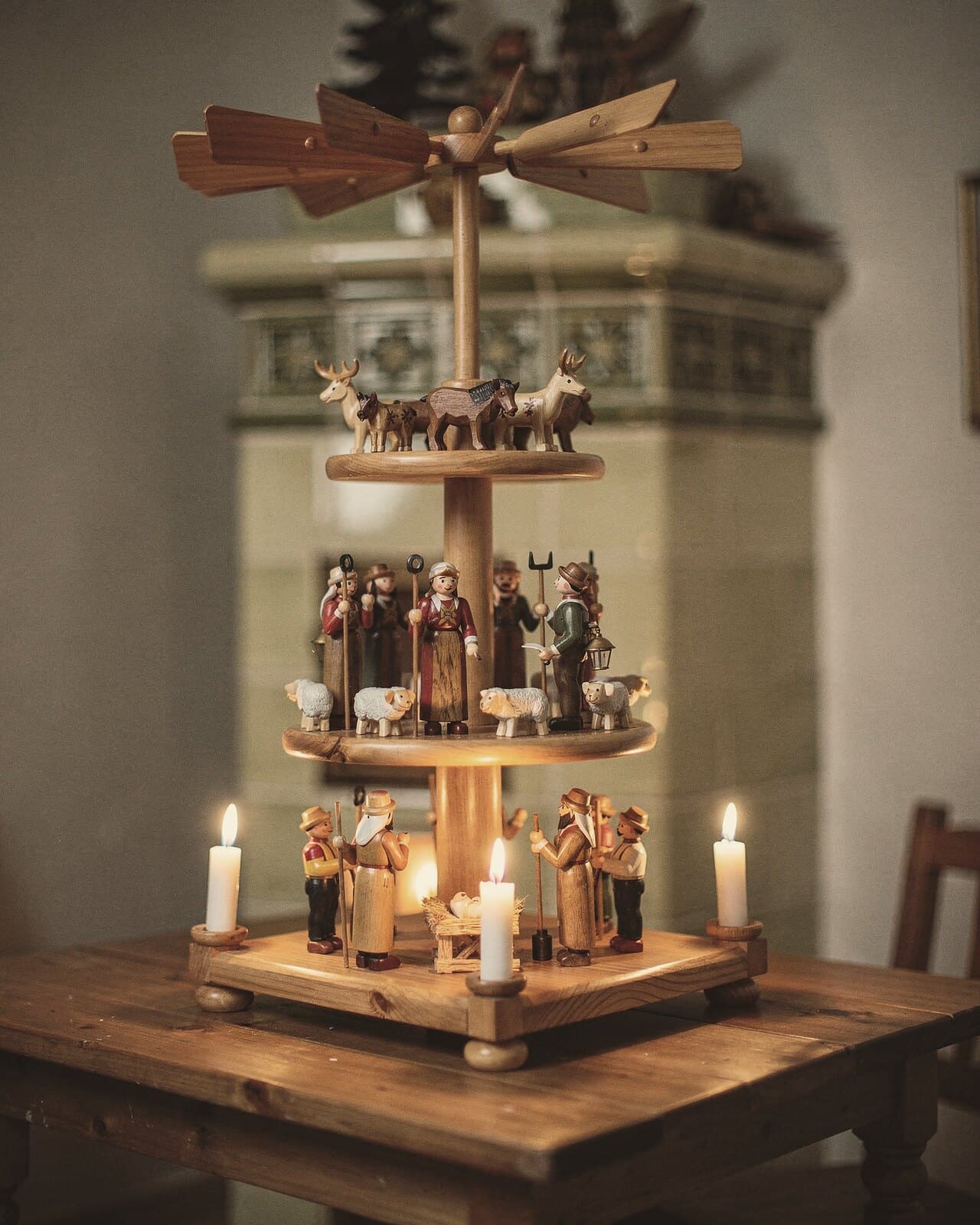
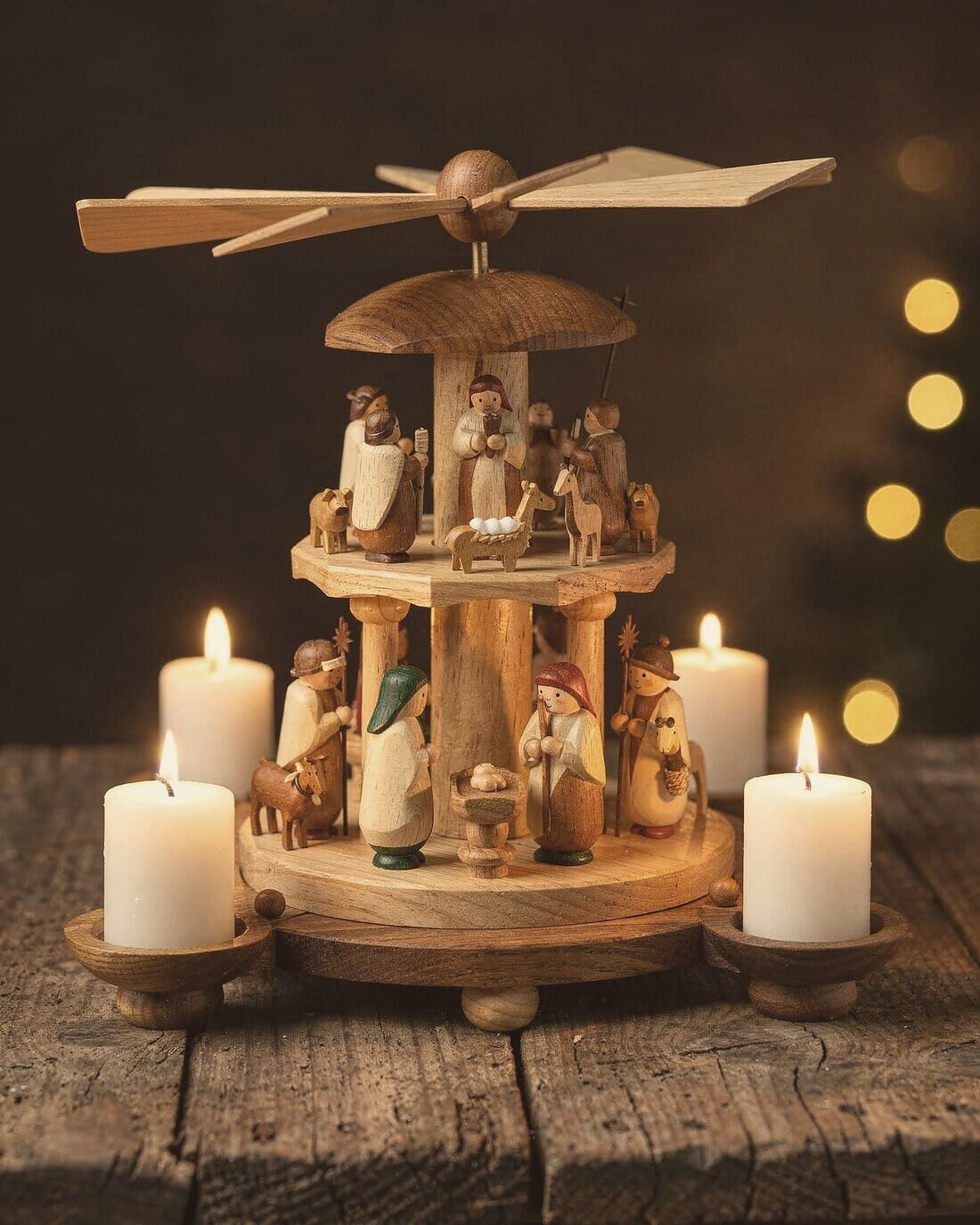
From the middle of the 1800s the Seiffen area made tiered pyramids, one plate above another, each with its own scene: the Nativity, the Three Kings, miners, forest animals, carol singers. They range from a single small tier for the table to the great outdoor pyramids of the towns, and the Seiffen toy museum’s central pyramid rises 6.30 meters (about 21 feet) through two floors.
The story
The pyramid began as a light stand. In the 18th century many German homes set up a frame of poles bound with greenery and candles at Christmas; Berlin’s markets sold them as Perjemiden. When the railways brought cut Christmas trees into the cities, the frames vanished almost everywhere. In the Erzgebirge they learned to turn, and so they survived.
By around 1800 the turning pyramid had appeared. The oldest to survive, dated about 1810 and named for a former owner, stands in the Erzgebirge Museum in Annaberg-Buchholz: four carved and painted tiers under ten large vanes, with a miners’ parade at the bottom, the Nativity with the Three Kings and the shepherds above it, then animals, camels among them, and angels at the top. Miners called such pyramids Laaflechter, “running lights,” and saw in their turning shaft the horse-driven hoists above the old mine shafts. Whether the hoist was the model, no one can prove.
The first series of pyramids made for sale in Seiffen dates from 1923. Ten years later the towns began to build giant ones: the first turned in Frohnau, today part of Annaberg-Buchholz, in December 1933, and the oldest still in use stands in Schwarzenberg. By 2014 the Erzgebirge district had about 150. Dresden’s Striezelmarkt pyramid, 14.62 meters (48 feet) tall, is listed by Guinness World Records as the largest Erzgebirge step pyramid; Johanngeorgenstadt’s, unveiled in 2014 at over 26 meters (85 feet), is in the town’s own words the largest in the Ore Mountains.
How it works
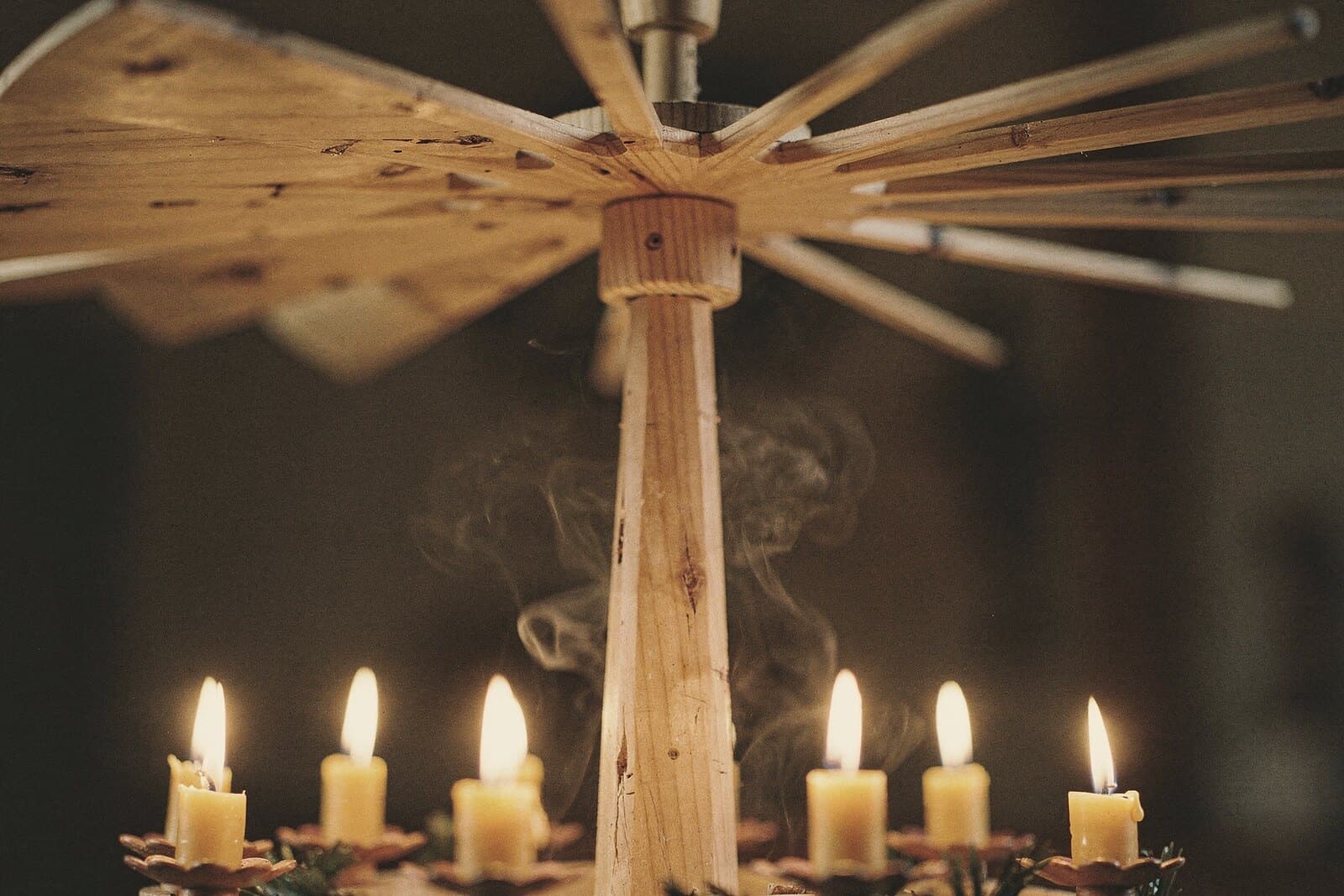
Candles at the base warm the air; the warm air rises and presses against the tilted blades of the vane wheel, the Flügelrad, at the top. The wheel sits on a central shaft that carries the tiers of figures, and the shaft stands on a fine metal tip in a little glass or ceramic cup, a bearing with almost no friction.
Use and care
Candles. Use the size your pyramid was made for. Most Erzgebirge pyramids take 14 mm (about 9/16 inch) pyramid candles, larger ones about 17 mm (11/16 inch), and some small ones run on tealights. A small pyramid candle of about 2½ to 3 inches burns for roughly an hour. No candle is truly drip-free, so press each one firmly and straight into its holder.
Setting it turning. Stand the pyramid on a level, stable surface, out of drafts. Light all the candles: more candles mean warmer air and faster turning. That, according to Chemnitz University of Technology, is why a pyramid often turns more slowly on the first Sunday of Advent than on the fourth. If it won’t turn, check that the shaft’s tip sits in its glass bearing, that the blades are evenly angled (about 45 degrees turns best) and that nothing rubs.
Safety. Keep a lit pyramid at least 12 inches (30 cm) from curtains and anything else that burns, and at least 3 feet (90 cm) from the Christmas tree. Keep it out of reach of children and pets. Put the candles out when you leave the room.
Between Christmases. Dust with a soft, dry brush and store the pyramid in its box in a dry room. Bent vane wheels, lost glass bearings and candle holders can be replaced. Electric pyramids, turned by a small motor, also exist; European models run on 230 volts and are not made for American outlets.
Related pieces
 No. I
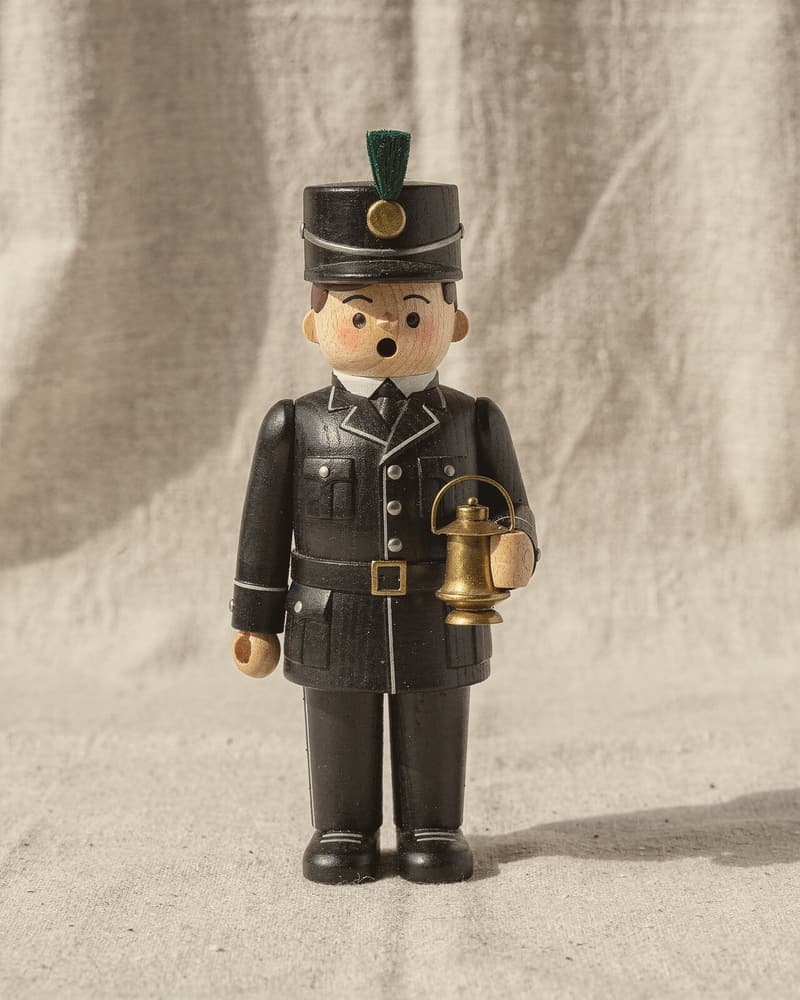
No. IDer Räuchermann
The smokerA little turned figure that puffs fragrant smoke from an incense cone hidden inside.
 No. IV
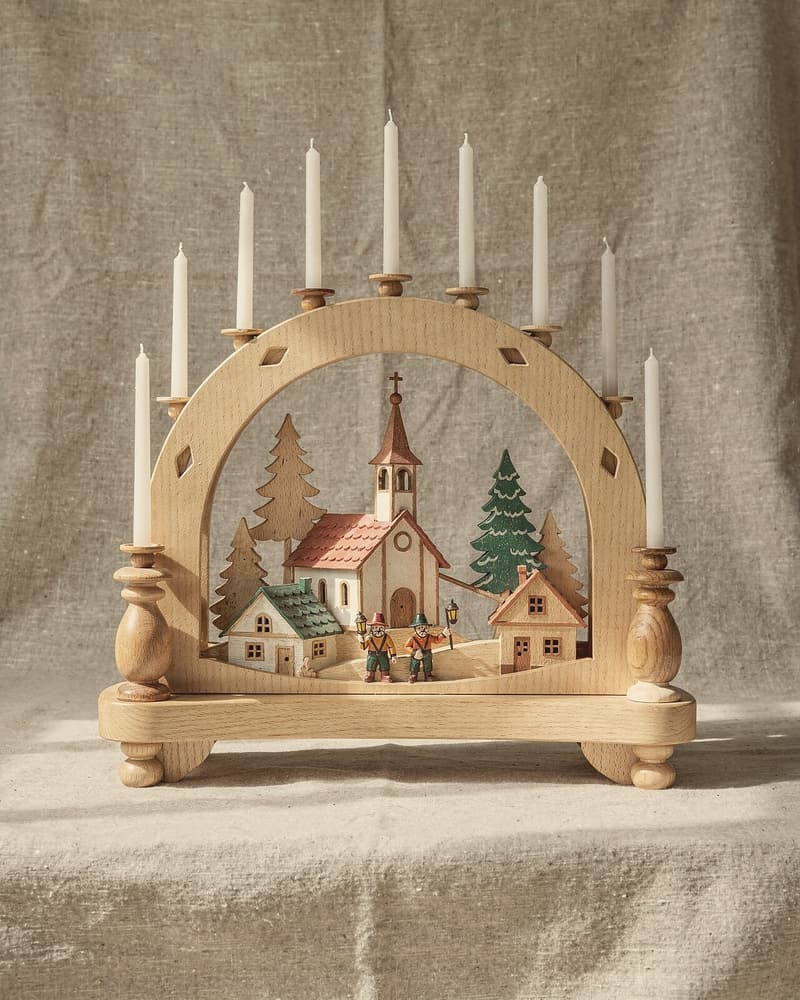
Der Schwibbogen
The candle archAn arch of lights for the winter window, first forged in iron in 1740.
 No. V
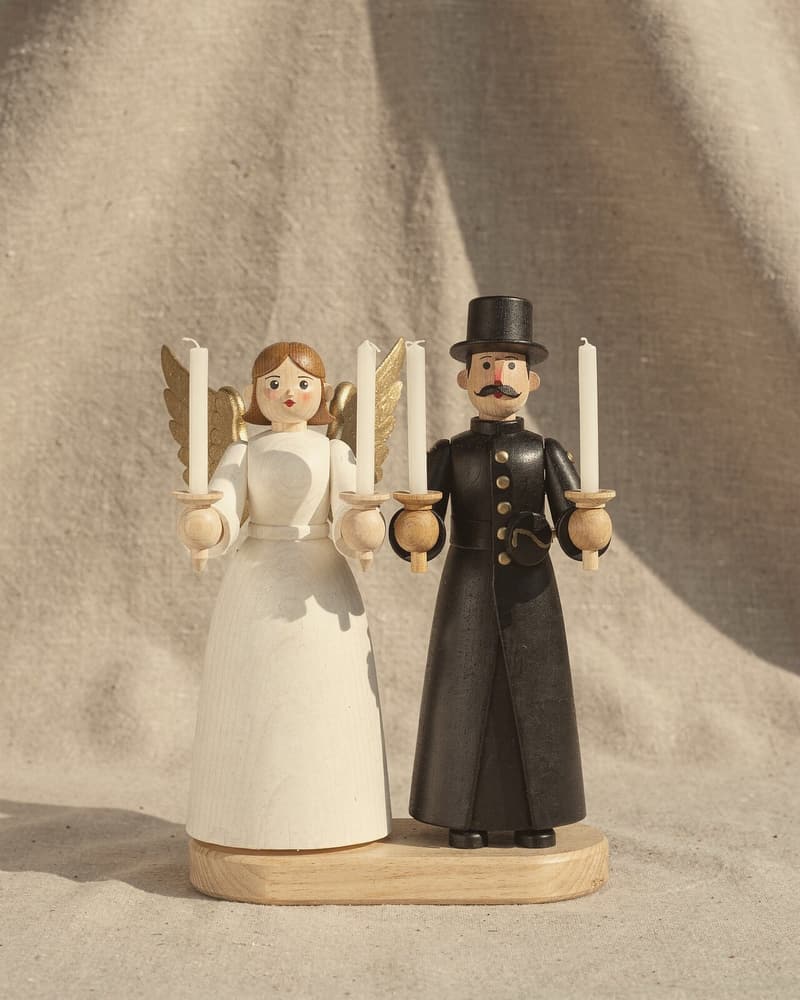
No. VEngel und Bergmann
Angel and minerThe candle-bearing pair, a miner in parade dress and an angel in white, since the 1830s.
Sources
- Erzgebirgsmuseum Annaberg-Buchholz, the Lenz pyramid (catalog record)
- Museum Europäischer Kulturen, Staatliche Museen zu Berlin, “Weihnachtspyramiden. Tradition und Moderne”
- Erzgebirgisches Spielzeugmuseum Seiffen, “Weihnacht im Museum”
- Siegfried Sieber, “Bergmännische Weihnachtsbräuche im Erzgebirge,” Der Anschnitt (1959)
- TU Chemnitz, Why does the Christmas pyramid turn? (2013)
- German Wikipedia, “Weihnachtspyramide”
- U.S. Fire Administration, Holiday fire safety