Engel und Bergmann: Angels and Miners
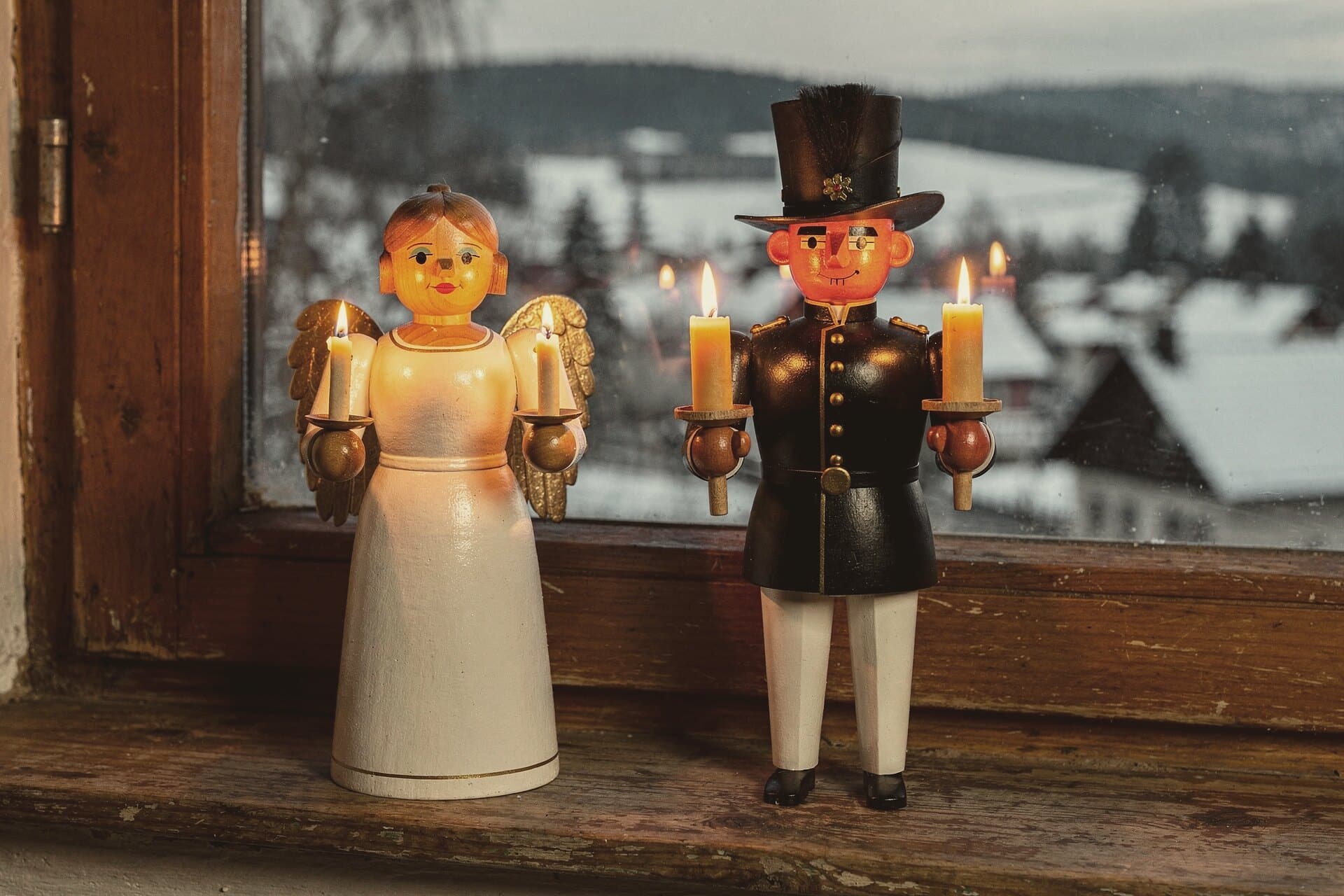
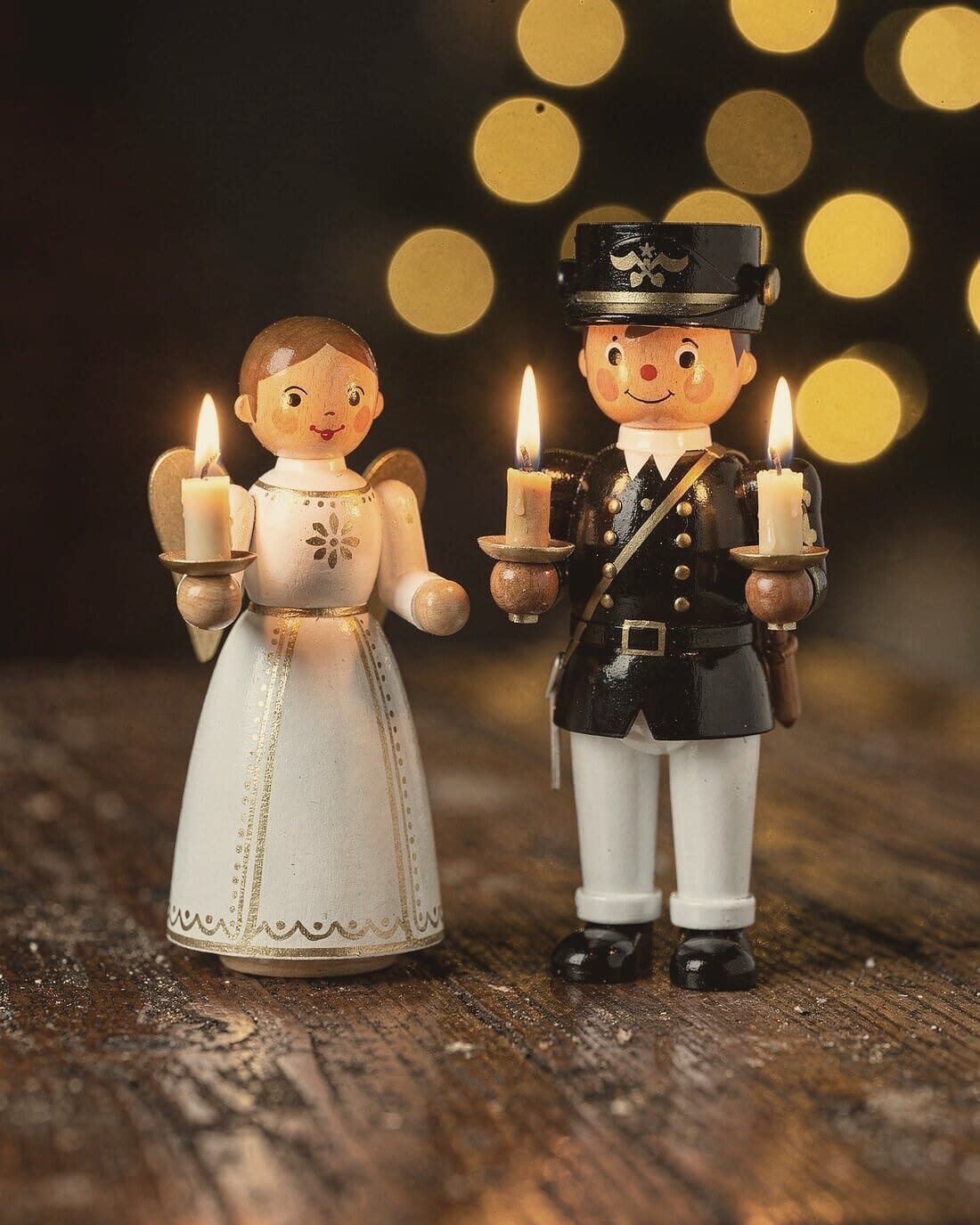
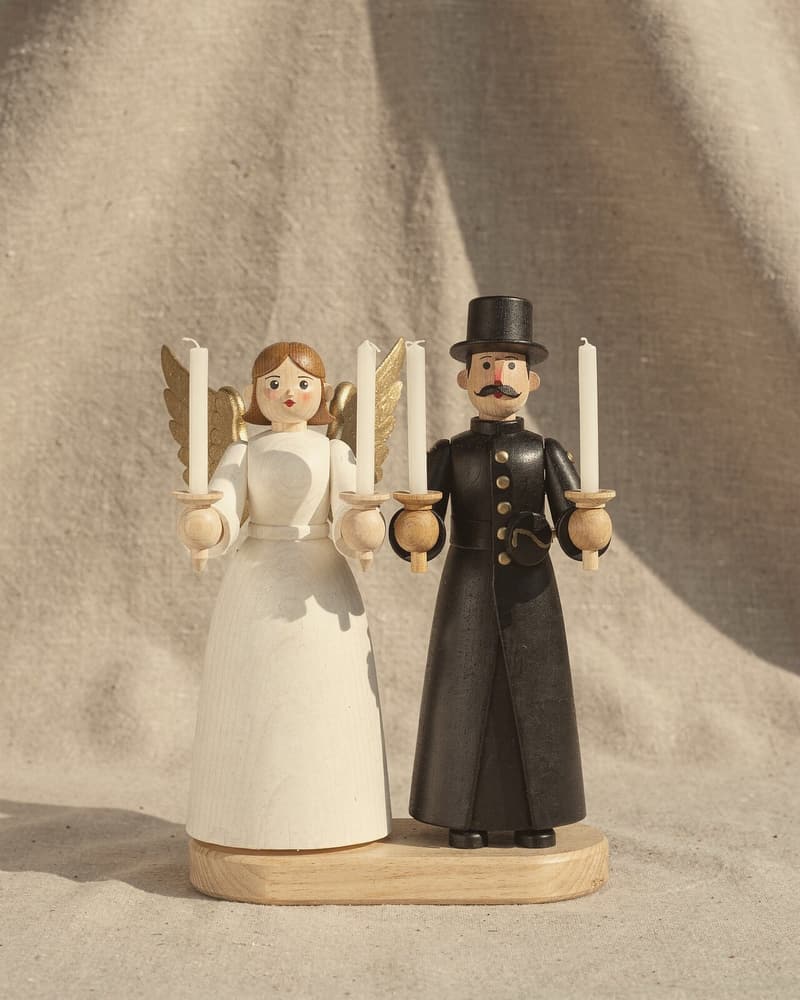
A miner in black parade dress and an angel in a long white gown, each holding candles. In the Erzgebirge they stand together in almost every Christmas room. The angel was born in the 1830s; the miner’s candles are older.
Styles
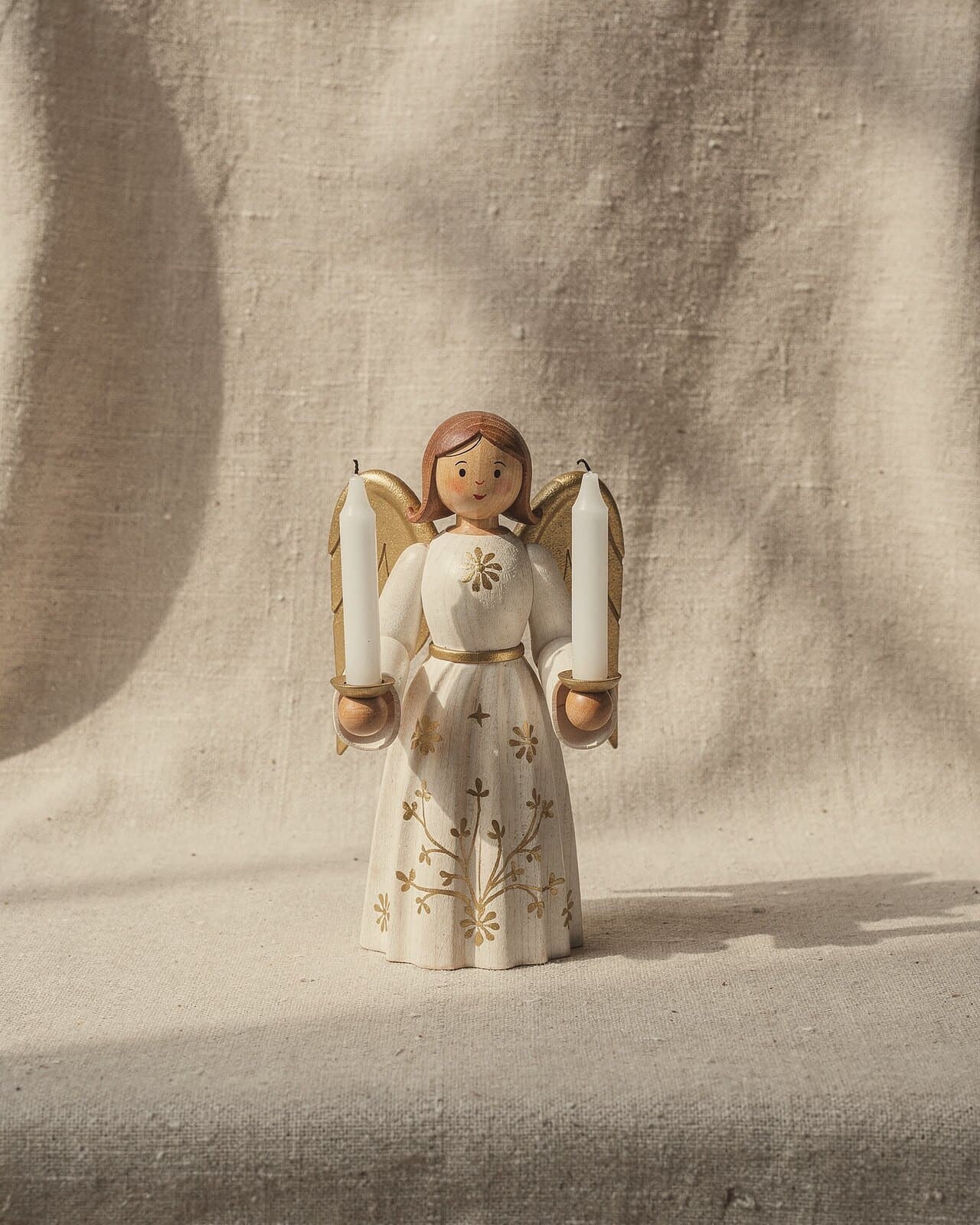
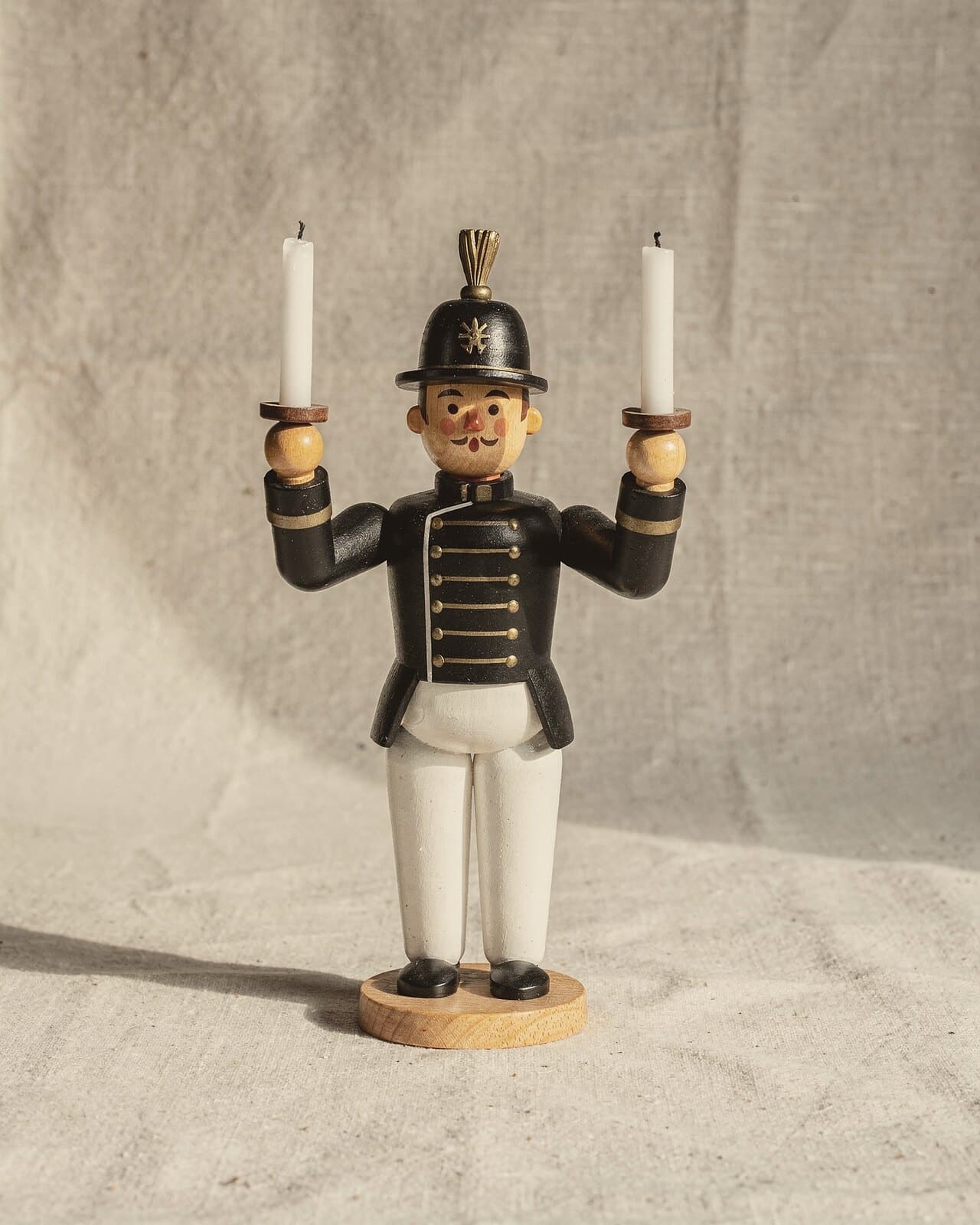
The angel wears a long white dress after the women’s fashion of the 1830s, often in two or three tiers with ruffled hems; from that decade on, a red apron with green zigzag trim marks the classic Erzgebirge angel. The miner wears the parade dress fixed by Saxon rule in 1768: tall green shaft hat, black smock, leather apron, white trousers, black shoes. A foreman’s figure is grander, with crest and plume. Makers matched the two in size, shape and color, so they belong together.
The story
The miner held a light long before he came home for Christmas. From the 1670s, figures of miners in pewter or wood stood on the altars of the mining towns’ churches and held the two altar candles: in Schneeberg from 1674, in Geising from 1685, in Annaberg’s miners’ church from 1715. Some still do. By the late 1700s miners were carving simple figures of themselves; the Freiberg mining calendar mentions their woodcarving in 1774.
The angel is younger. The turned candle angel, standing in her gown with a candle socket and wooden wings, is a creation of the Biedermeier years; despite real effort, the folklorist Karl Ewald Fritzsch found no example earlier than about 1830. She may have been modeled on the foil “tinsel angels” of Nuremberg. Paired with the miner, she spread from the workshops of Seiffen across Saxony and Germany, above all into mining country, and became, in Fritzsch’s words, a symbol of the Erzgebirge Christmas.
What do they stand for? Some say the angel is the miner’s wife; Fritzsch rejected that as a modern rationalization. The white angel came from religion, and in the old Christmas plays of the mountains the angels were often played by young miners in long white shirts. Some families say they once set a miner in the window for every son and an angel for every daughter. It is a lovely custom, though no historian has found it in the old records.
How they’re made
Both figures are, at heart, turned work. Body, head and skirt come off the lathe; the angel’s wings and other small parts are cut or carved separately and glued on; then each is painted, the miner’s black and white uniform with its insignia, the angel’s dress and gilding. Floating angels, hung from the ceiling as candleholders, have been made around Seiffen since the second half of the 1800s.
Use and care
Use candles that sit firmly in the holders; many figures today are lit electrically instead, and then the bulb rules for candle arches apply, including 120-volt current in the United States. Never leave lit candles unattended, and keep the figures clear of curtains and anything else that can burn. Wings, candle holders and lamps are delicate: lift a figure by its body, not by its arms or wings.
Dust with a soft, dry brush, keep the pair out of direct sun and damp, and store them in their box in a dry room between Christmases.
Related pieces
 No. IV
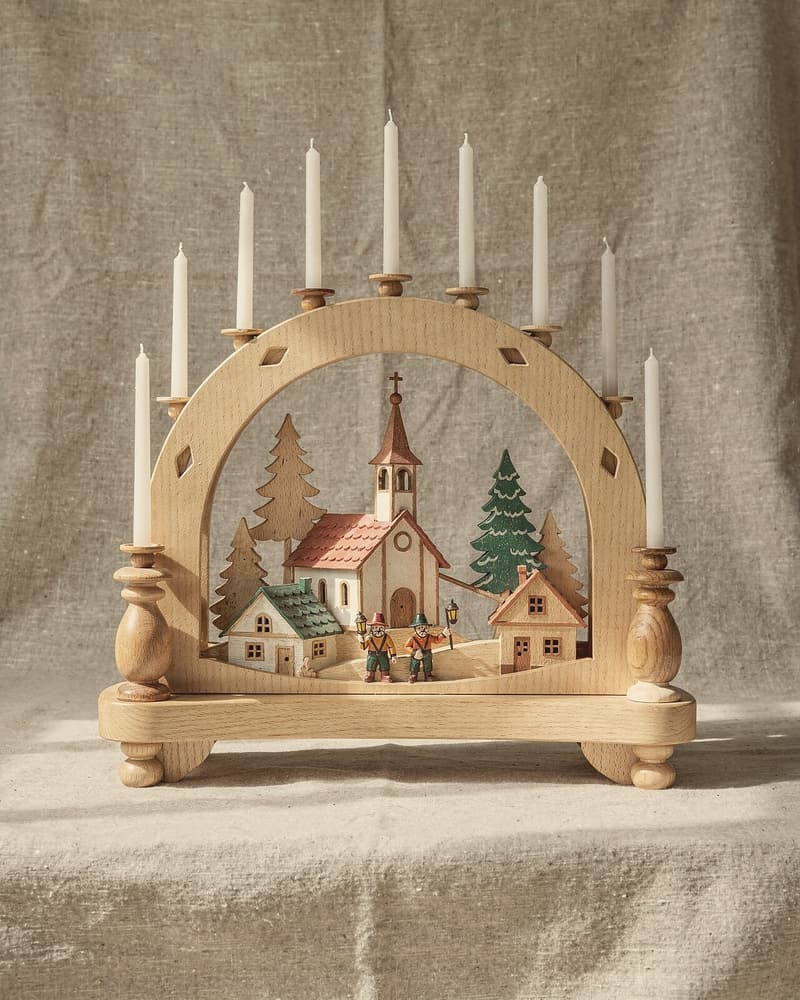
Der Schwibbogen
The candle archAn arch of lights for the winter window, first forged in iron in 1740.
 No. II
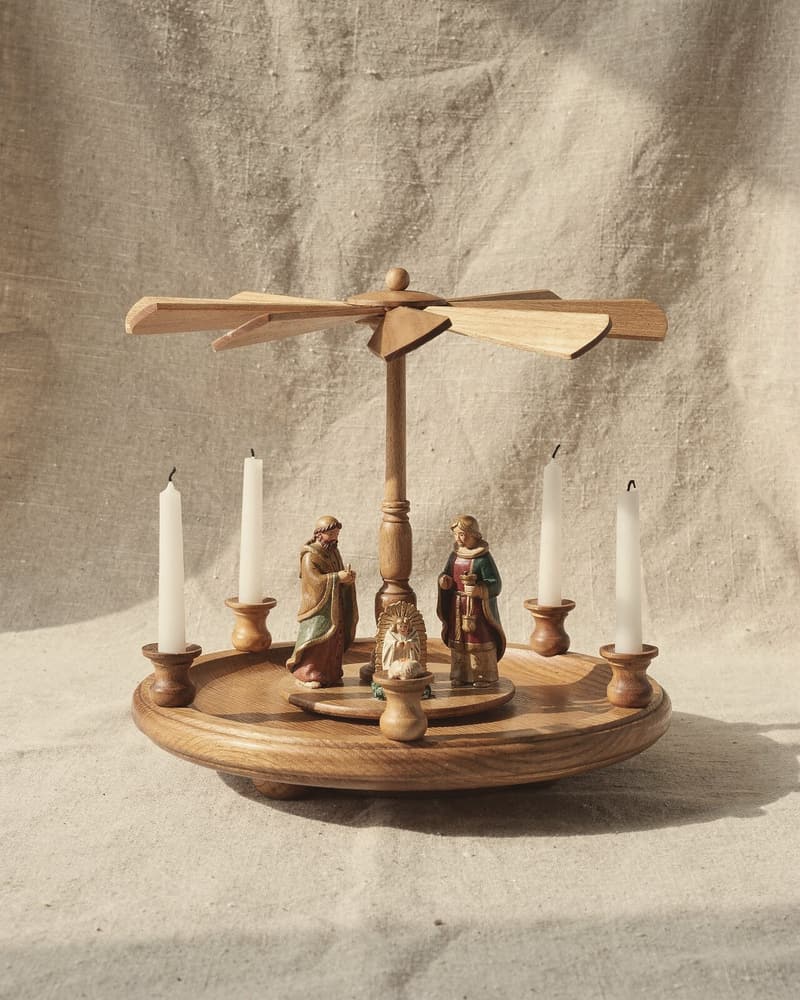
Die Weihnachtspyramide
The Christmas pyramidA carousel of figures on tiers, turned by nothing but the warmth of its candles.
 No. I
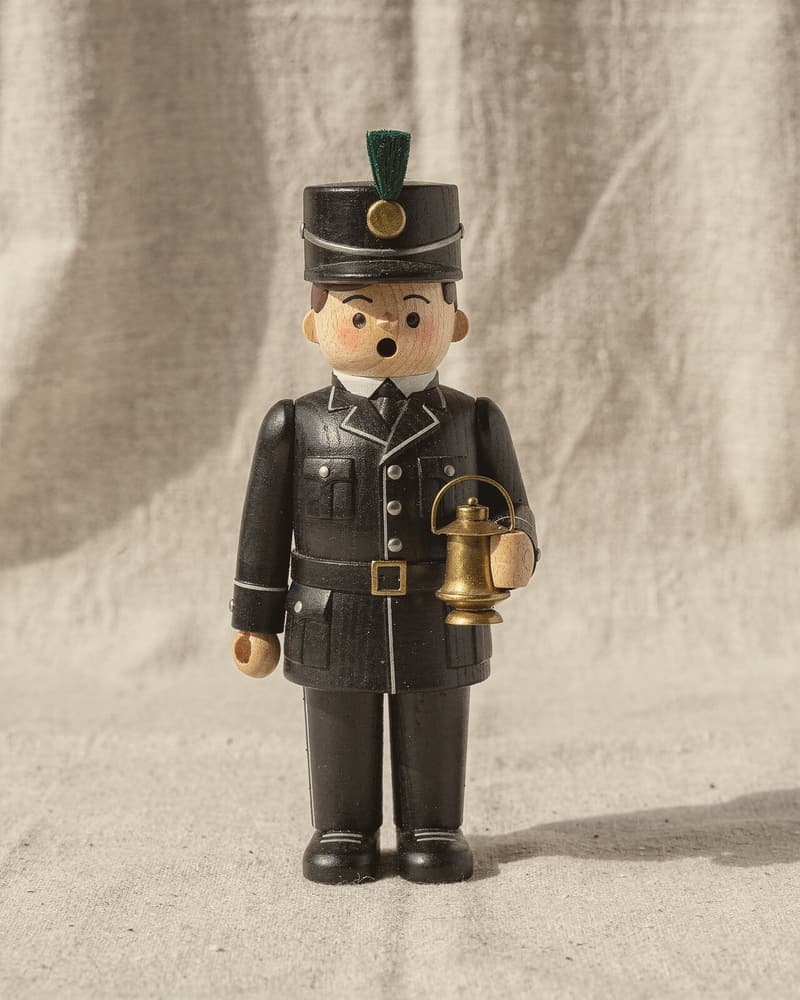
No. IDer Räuchermann
The smokerA little turned figure that puffs fragrant smoke from an incense cone hidden inside.
Sources
- Karl Ewald Fritzsch, “Bergmann und Engel als weihnachtliche Lichterträger,” Der Anschnitt (1959)
- Siegfried Sieber, “Erzgebirgische Bergmannsfiguren aus Holz und Zinn,” Der Anschnitt (1959)
- Siegfried Sieber, “Bergmännische Weihnachtsbräuche im Erzgebirge,” Der Anschnitt (1959)
- Erzgebirgisches Spielzeugmuseum Seiffen, “Weihnacht im Museum”