Agricola’s Book of Mines
A town doctor in a silver boomtown spent twenty-five years on the great book of mining. It was printed after his death, refused a grave in his own city, and translated into English by a future American president.
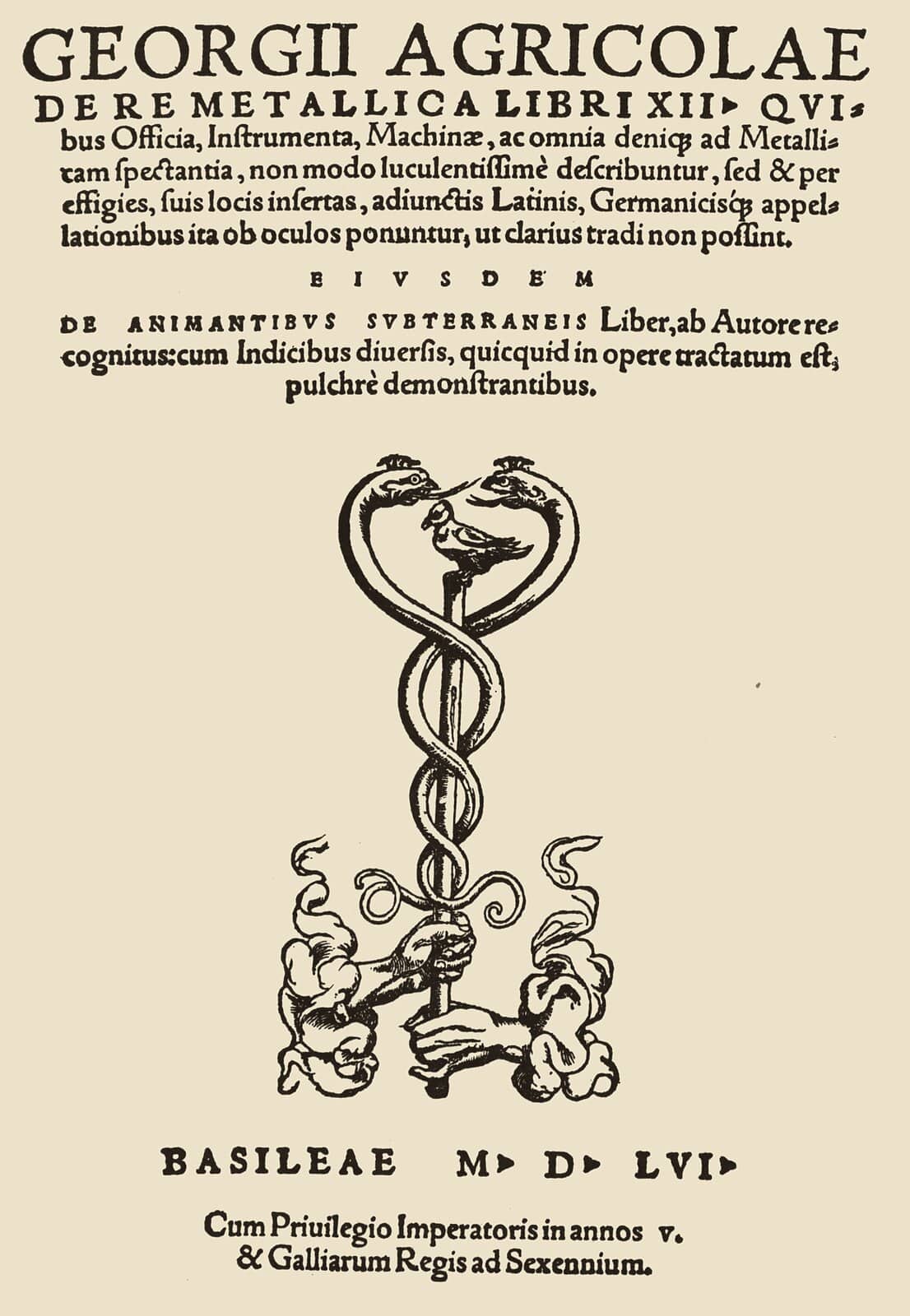
In 1527 a young doctor arrived in Joachimsthal, a silver town on the Bohemian side of the Erzgebirge that had not existed eleven years before. He was the new town physician and apothecary. By his own account he spent every hour his patients left him in the mines and smelting works, reading everything the Greeks and Romans had written about metals and talking with the most experienced mining men he could find. Before long he owned shares in a mine himself. “We, as a shareholder, through the goodness of God,” he wrote later, “have enjoyed the proceeds of this God’s Gift since the very time when the mine began first to bestow such riches.”
His name was Georg Bauer. The world knows him as Georgius Agricola, and the book he began in those years, De re metallica, became the great mining book of the Renaissance.
The farmer who was a scholar
He was born on March 24, 1494, in Glauchau, in Saxony, the son of a cloth maker and dyer. Bauer means farmer, and agricola is the Latin for it: a scholar’s name, probably given him by his teachers. He studied the classics in Leipzig and taught at the town school in Zwickau, where his Latin grammar of 1520 already drew its examples from mining. One exercise reads, in German translation, “Under the earth creep the shafts of greed.”
In Italy he studied medicine at Bologna and probably Padua, and worked in Venice for the famous Aldine press on an edition of the Greek physician Galen. Then he came home, to the mountains and the mines.
Why would a doctor write about mining? Practicing medicine in mining country let him learn the work at first hand, and much of what he saw was illness: the cold water in the shafts, the bad air, the dust that, he wrote, “penetrates into the windpipe and lungs.” His first mining book, a dialogue called Bermannus, appeared in Basel in 1530, with a letter of praise from Erasmus at the front. In the early 1530s he moved to Chemnitz as town physician, and in 1546 a volume of his geological works followed, including what has been called the first systematic mineralogy.
Twenty-five years for one book
De re metallica took a quarter of a century. A friend mentioned it in a letter to Erasmus in 1529; in 1533 Agricola promised “the twelve books” if he lived; the dedication to the Saxon princes is dated December 1, 1550. Its twelve books run from the case for mining itself, through prospecting, veins, surveying, tools and machines, to assaying, smelting and the making of salt and glass.
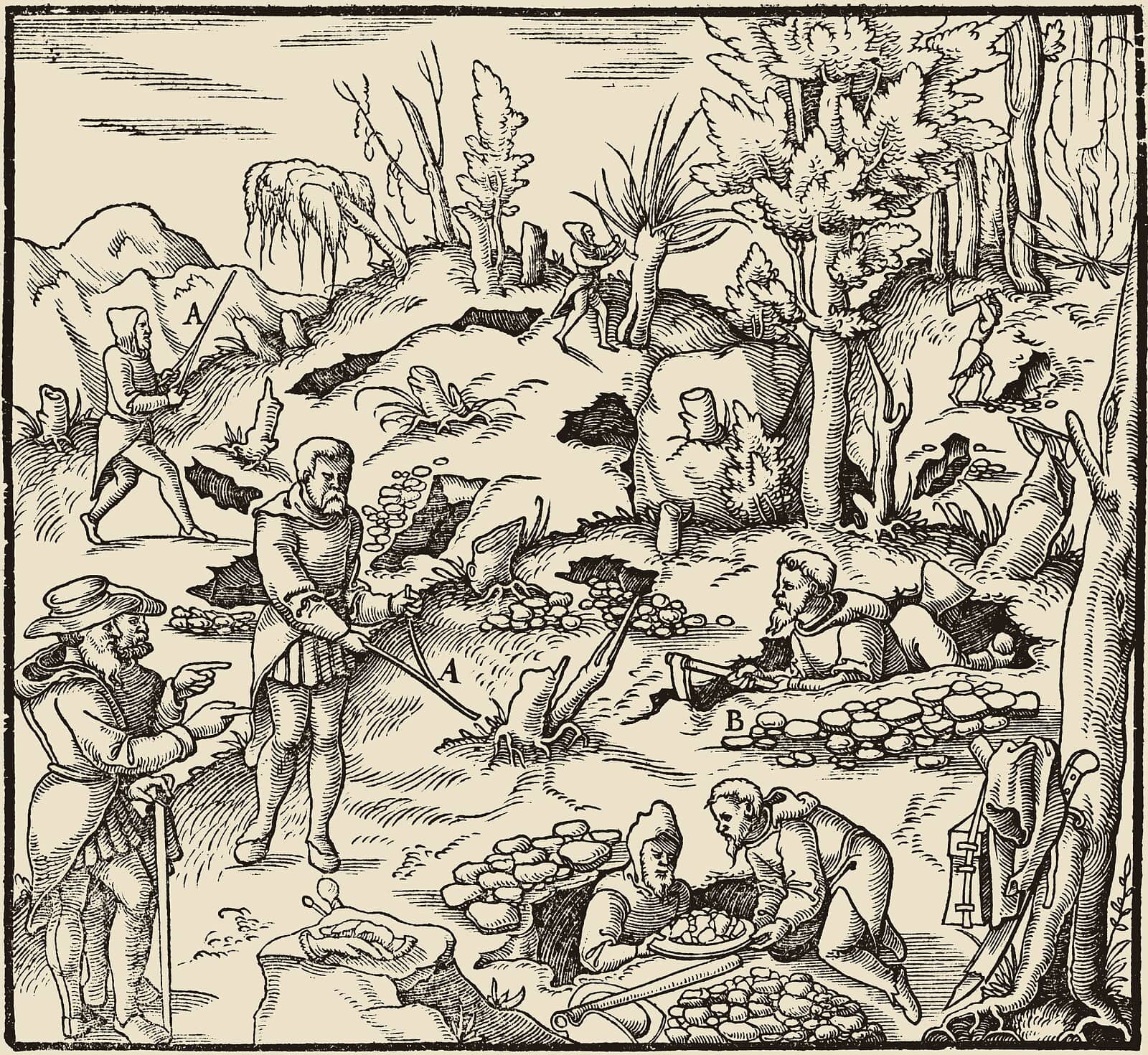
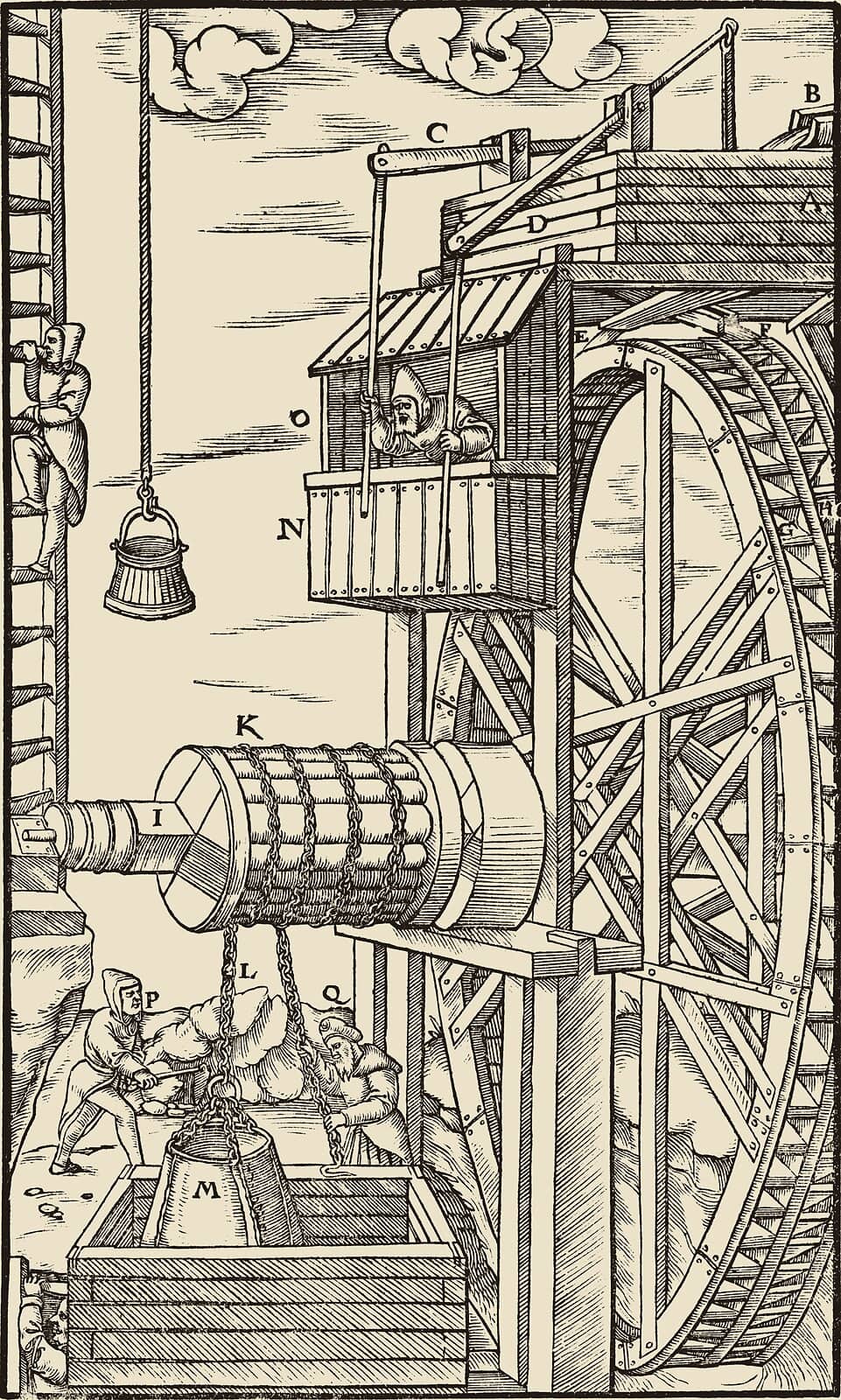
He wanted pictures. He had “hired illustrators to delineate their forms,” he explained, “lest descriptions which are conveyed by words should either not be understood by men of our own times, or should cause difficulty to posterity.” Finding them was hard. He searched in vain in Freiberg and Schneeberg, until an old draftsman from Joachimsthal, Basilius Wefring, wrote that his eyes were better again and offered his help. Agricola paid him, in his own words, “not without great expense.” In Basel the drawings were worked up and cut into wood by Hans Rudolf Manuel Deutsch and Zacharias Specklin. The first edition carries nearly three hundred woodcuts, and if you look closely, some of the miners swing their hammers left-handed and one treadwheel turns the wrong way.
I have omitted all those things which I have not myself seen, or have not read or heard of from persons upon whom I can rely.
Georgius Agricola, De re metallica, preface
Mayor in wartime
Chemnitz made the doctor its mayor four times, in 1546, 1547, 1551 and 1553, the years of the Schmalkaldic War, when the duke himself ordered his appointment. And Agricola stayed what he had always been: a Catholic, in a city that had become Lutheran. It was to cost him his grave.
A grave refused
He died in Chemnitz on November 21, 1555, at sixty-one. His friend Georg Fabricius wrote to Philipp Melanchthon that a man who had enjoyed robust health since childhood “was carried off by a four-days’ fever.” As a former mayor he was entitled to burial in the city’s main church, St. Jacobi. The Lutheran superintendent referred the matter to the elector, and the elector forbade it.
His friends sent a rider to another old friend, Julius Pflug, the Catholic bishop of Naumburg-Zeitz. On November 25 the body was carried out of Chemnitz, along the old road through Penig, Altenburg and Meuselwitz, some forty miles, and on November 26, 1555, Agricola was buried in the cathedral at Zeitz. His widow, Anna, hung a brass plate there; it had vanished by the 17th century. In 1934 a bronze tablet took its place, calling him “the father of mineralogy.”
He never saw his book in print. De re metallica appeared in Basel in 1556, months after his death.
The book outlives its author
It traveled far. A German version followed in 1557; it sold so poorly that a Frankfurt publisher later bought up the unsold stock; an Italian translation of 1563 was dedicated to Queen Elizabeth I of England, and a Spanish one of 1569 was wanted in the silver mines of Potosí, in the Andes. Eight editions between 1556 and 1657 were printed from the original woodblocks. For well over a century and a half, miners and smelters had no better guide.
Night hours in London
In 1905 a young American, Lou Henry Hoover, went looking for a good English translation of Agricola and found none. She and her husband, Herbert, both geology graduates of Stanford, decided to make one. She brought the Latin and the geology; he brought his experience as a mining engineer, and tested Agricola’s descriptions with experiments of his own. It was, they wrote in their preface of July 1, 1912, “a labour of love,” done in “night hours, weekends, and holidays, in all extending over a period of about five years.” They dedicated it to their old Stanford teacher, John Caspar Branner, and published it in London through The Mining Magazine.
In 1914 the Mining and Metallurgical Society of America gave Herbert Hoover its first gold medal for the work. Fifteen years later he became the 31st President of the United States. The translation was reprinted in 1950, and today anyone can read it free online.
Agricola, the doctor from Glauchau, had made the case for mining in his first book. “As the farmer, sowing his seed in his fields injures no one,” he wrote, “so the miner digging for his metals, albeit he draws forth great heaps of gold or silver, hurts thereby no mortal man.” Four and a half centuries later his book still opens the history of the mountains whose name means ore.
Quotations from Agricola and Fabricius follow the English translation by Herbert and Lou Henry Hoover (1912). Short quotations from German sources are our own translations.
Sources
- Georgius Agricola, De re metallica (1556), trans. H. C. and L. H. Hoover (1912), Project Gutenberg
- Neue Deutsche Biographie, Georgius Agricola
- Friedrich Naumann, “450 Jahre ‘De re metallica libri XII’” (2006)
- Gisela-Ruth Engewald, “Zum 450. Todestag von Georgius Agricola”
- Herbert Hoover Presidential Library and Museum, “De Re Metallica translated” (2016)
- Herbert Hoover Presidential Library and Museum, “The discovery of a professional tradition” (2016)
- Swiss National Museum blog, Agricola’s 16th-century bestseller (2022)
- City of Glauchau, the Agricola monument
More stories
How the nutcracker came to America
A carved nut-biter from the German mountains, a king from Seiffen, a ballet that bored its first audience, and a Christmas Eve in San Francisco. How the nutcracker became an American Christmas.
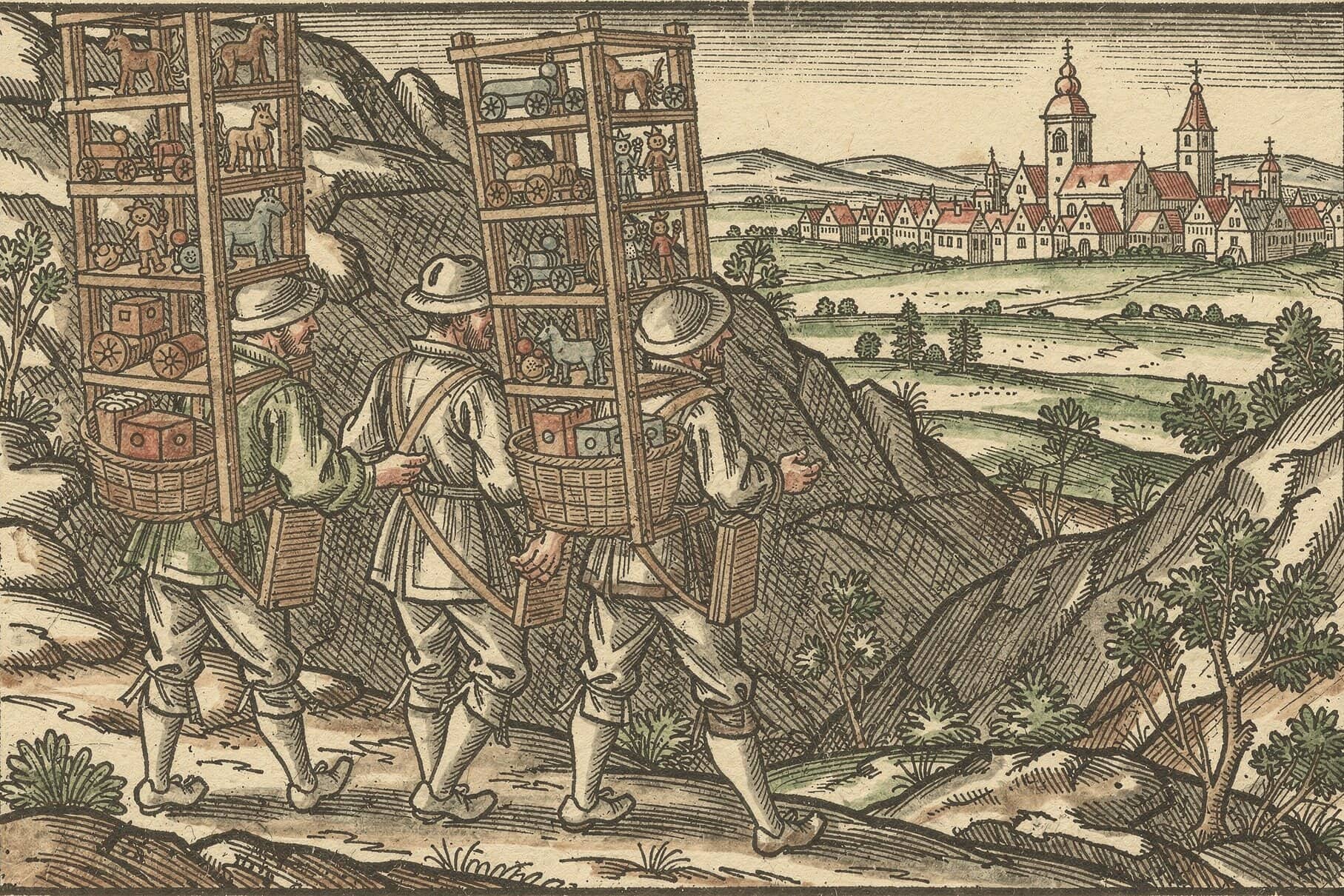
How Seiffen’s toys went out into the world
A linen trader’s wheelbarrow, merchants in the middle, crates on the Spanish silver fleet and four turners at a Dresden Christmas market. How a mountain village’s toys reached the world, and what they earned the families who made them.
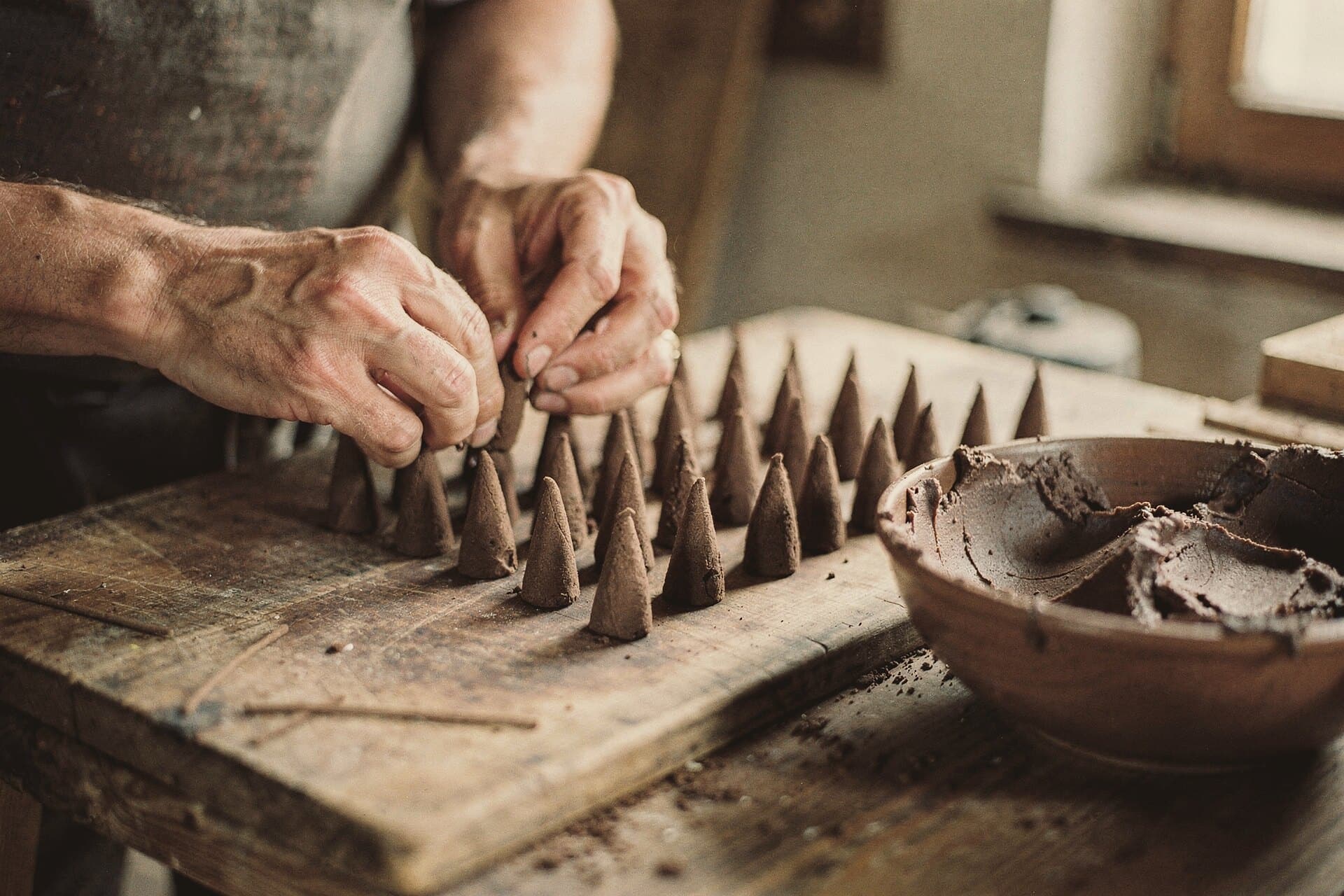
Of smoke and incense cones
Frankincense against the spirits of the twelve nights, a dough of charcoal and beech flour, a kitchen in Crottendorf and a turner’s idea about pipes. The story of the smoker and the little cone that makes him smoke.