Of smoke and incense cones
Frankincense against the spirits of the twelve nights, a dough of charcoal and beech flour, a kitchen in Crottendorf and a turner’s idea about pipes. The story of the smoker and the little cone that makes him smoke.
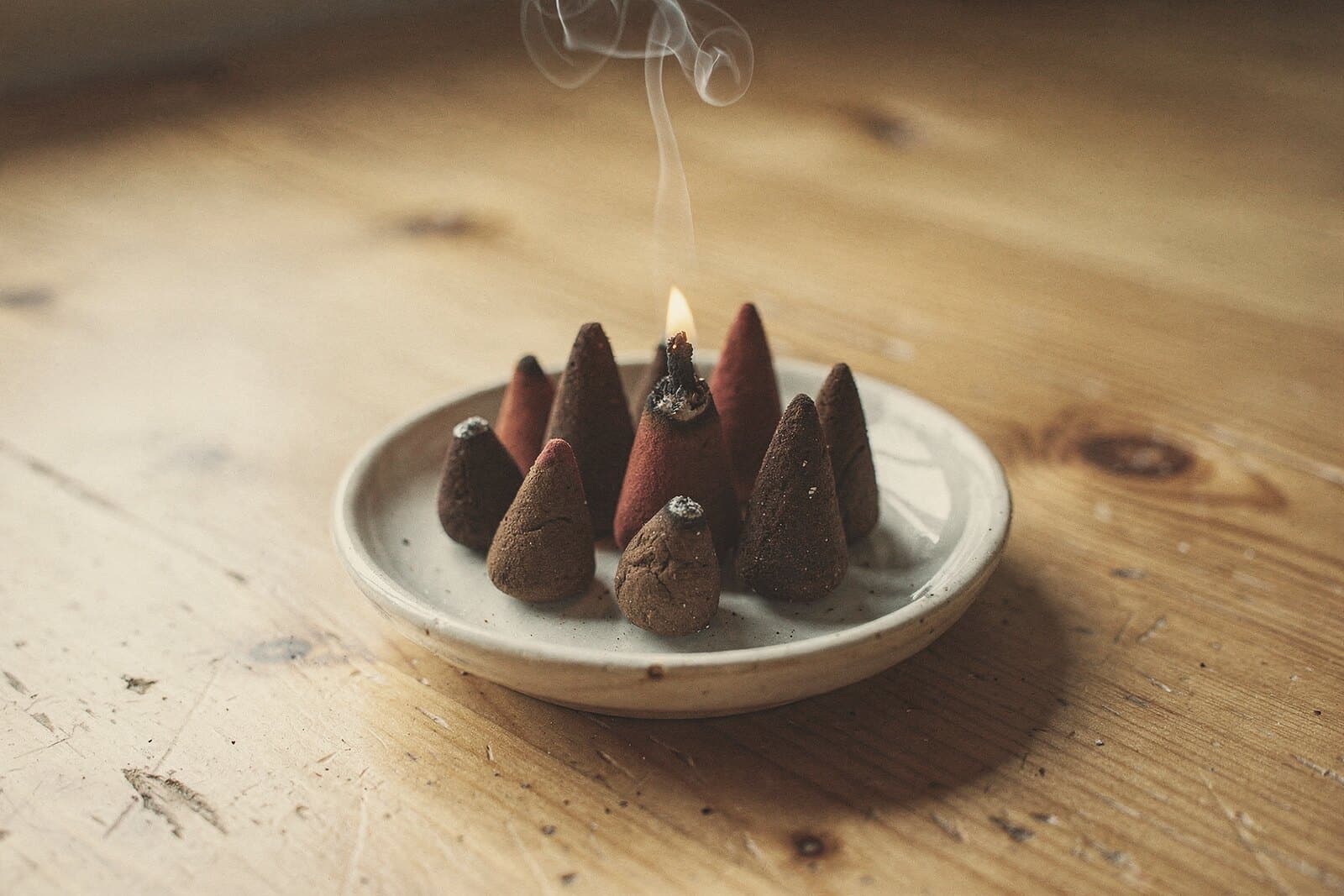
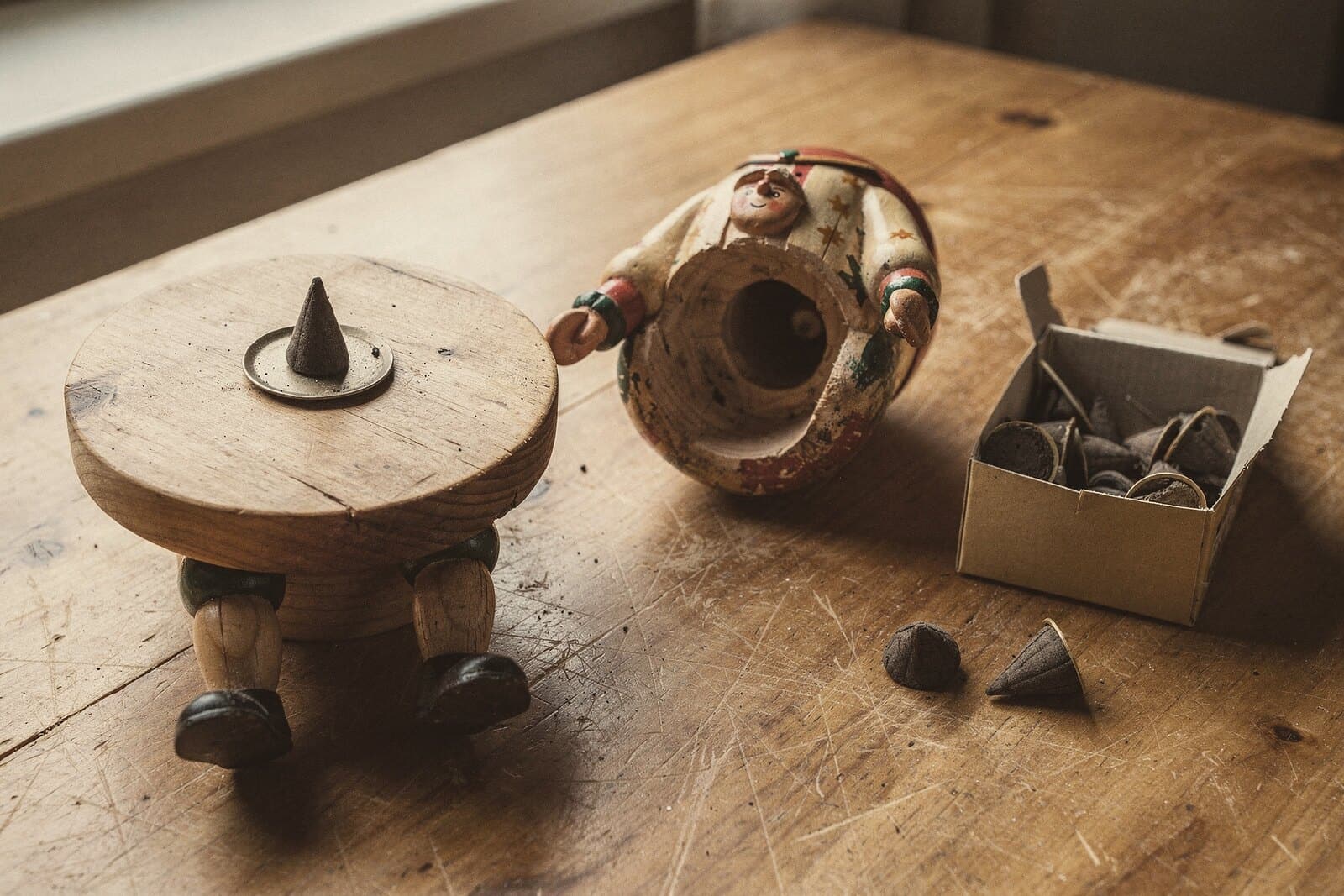
Lift the upper body off a smoker and you find a little tin plate on a wooden disc. Set a cone of dark incense on it, light the tip, blow out the flame so that the tip glows orange, and put the body back on. After a moment a thread of smoke curls from the little man’s mouth, and the room begins to smell of frankincense, fir or honey. “For centuries,” says the toy museum in Seiffen, “the scent of frankincense has belonged to Christmas in the Erzgebirge.”
The figure is younger than the cone, and the scent is older than both. This is the story of all three.
The older smoke
People burned frankincense at midwinter long before anyone turned a smoker. It had been burned in churches for centuries, and in houses too. In 1534 the humanist Sebastian Franck wrote that in the twelve nights between Christmas and Epiphany there was no house that did not make frankincense smoke every day, to keep away devils, ghosts and sorcery. He was describing the German lands in general, and an earlier writer, Johannes Boemus, had reported the same in 1520.
In the twelve nights between Christmas and Holy Three Kings’ Day there is no house that does not make frankincense smoke in its dwelling every day, against all devils, ghosts and sorcery.
Sebastian Franck, Weltbuech, 1534
Even the name of those nights is argued over. Some derive Rauhnacht from an old word for “hairy,” perhaps for spirits in fur; others from the custom of smoking out the stables with frankincense, which would make them Rauchnächte, “smoke nights.” Each side calls the other’s explanation folk etymology.
Charcoal, beech and resin
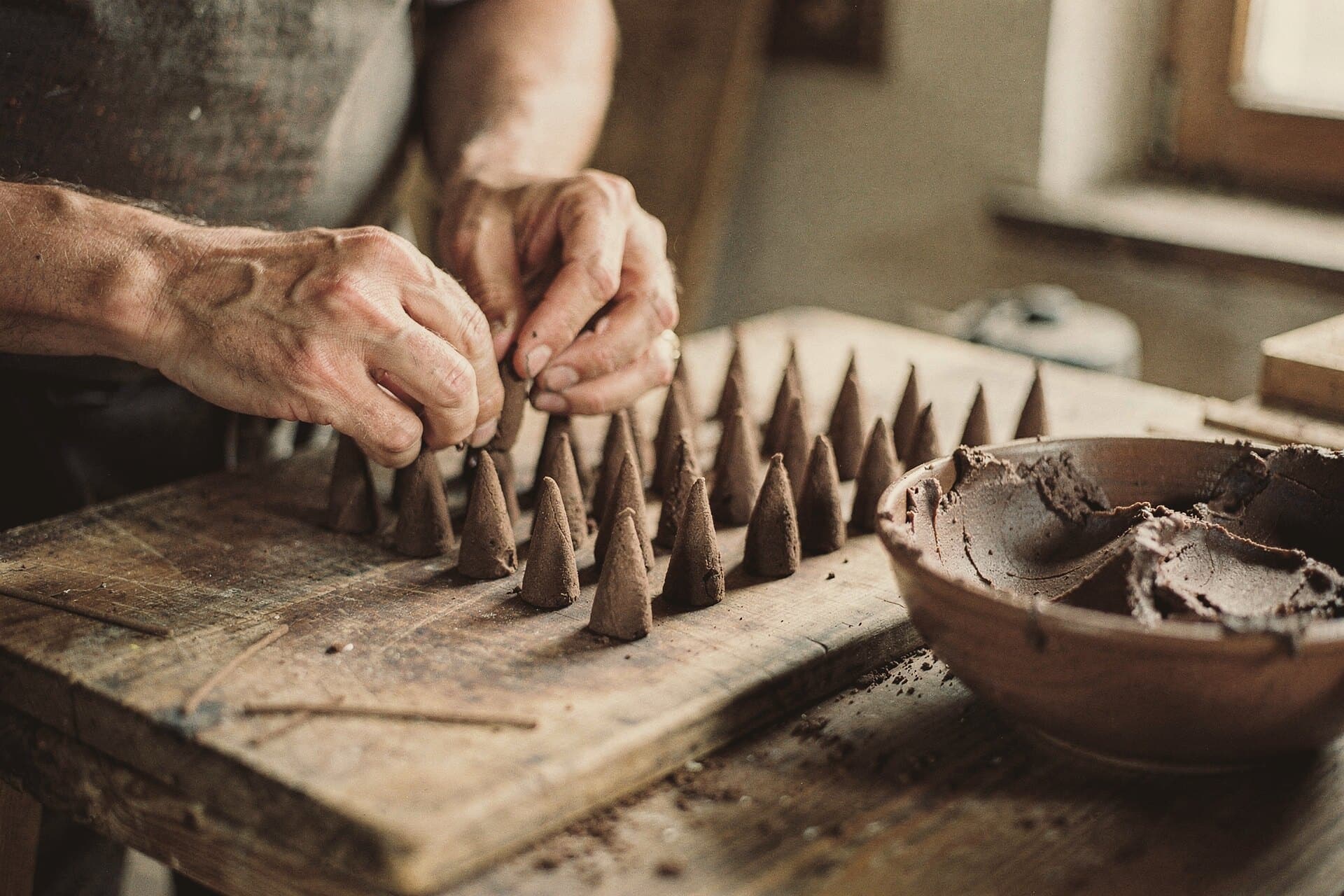
The incense cone itself, the Räucherkerze or “smoking candle,” is a product of the mountains. The Seiffen museum says hand-formed cones were being made in the western Erzgebirge before 1800, and the village of Crottendorf, high on the northern slope of the Fichtelberg, dates its own tradition to about 1750. At first, the village’s history says, the cones were simply set on a dish and burned.
The recipe is short. Ground charcoal makes the cone glow; red-beech wood flour gives it body; potato starch binds it; and the scent comes from frankincense resin, sandalwood or other fragrances. The ingredients are mixed into a moist dough, shaped or pressed into cones, dried and packed. The traditional scents of Christmas are frankincense, fir, honey and cinnamon.
A kitchen in Crottendorf
For most of their history the cones were made the way one Crottendorf woman made them. Freya Graupner, born in 1888, helped keep her family by sewing braid, the village’s cottage industry. In 1918, her biographer writes, she began making incense cones by hand in her kitchen, a room of about ten square meters, roughly 110 square feet. Her handwritten recipes survive, recording how much charcoal, potato starch, sandalwood and frankincense went into each batch. The cones were sold “door to door from a peddler’s tray or carrying basket,” and at the markets of the nearby towns.
In 1936 she applied for a trade license to make them, which, under the law of the day, needed her husband’s consent. A shed beside the house became the workshop in 1955. Drying the cones was the slow part of the work, and it set the pace of everything else. Under the East German state, her business came partly under state ownership in 1959, and in 1972 she lost it altogether, when it was turned into a state enterprise for incense goods. She died in Crottendorf in 1974. Since 2021 a plaque in the village has counted her among Saxony’s notable women.
A pipe for the cone
The cone came first; the figure followed. Smoking figures of papier-mâché were made in Sonneberg, in Thuringia, around 1820 to 1830. In the Erzgebirge, the Seiffen museum suggests, the fashion of the day gave a toymaker his idea: “The rising popular (bad) habit of pipe smoking may well have given the toymaker the idea of setting the fragrant incense cone inside a hollow-turned figure.” Tradition credits turners in Heidelberg, a village next to Seiffen, around 1850, among them Ferdinand Frohs, and names his nephew, Gotthelf Friedrich Haustein, beside him. Their first smokers had arms, feet and faces formed from dough.
The way a smoker works has hardly changed. The figure comes apart in two. The lower half, with the base and the legs, carries a thin wooden disc with a small metal plate for the cone; the hollow upper body fits over it. Fresh air comes in through a hole or notch at the back, keeps the cone glowing, and pushes the smoke up and out through the mouth.
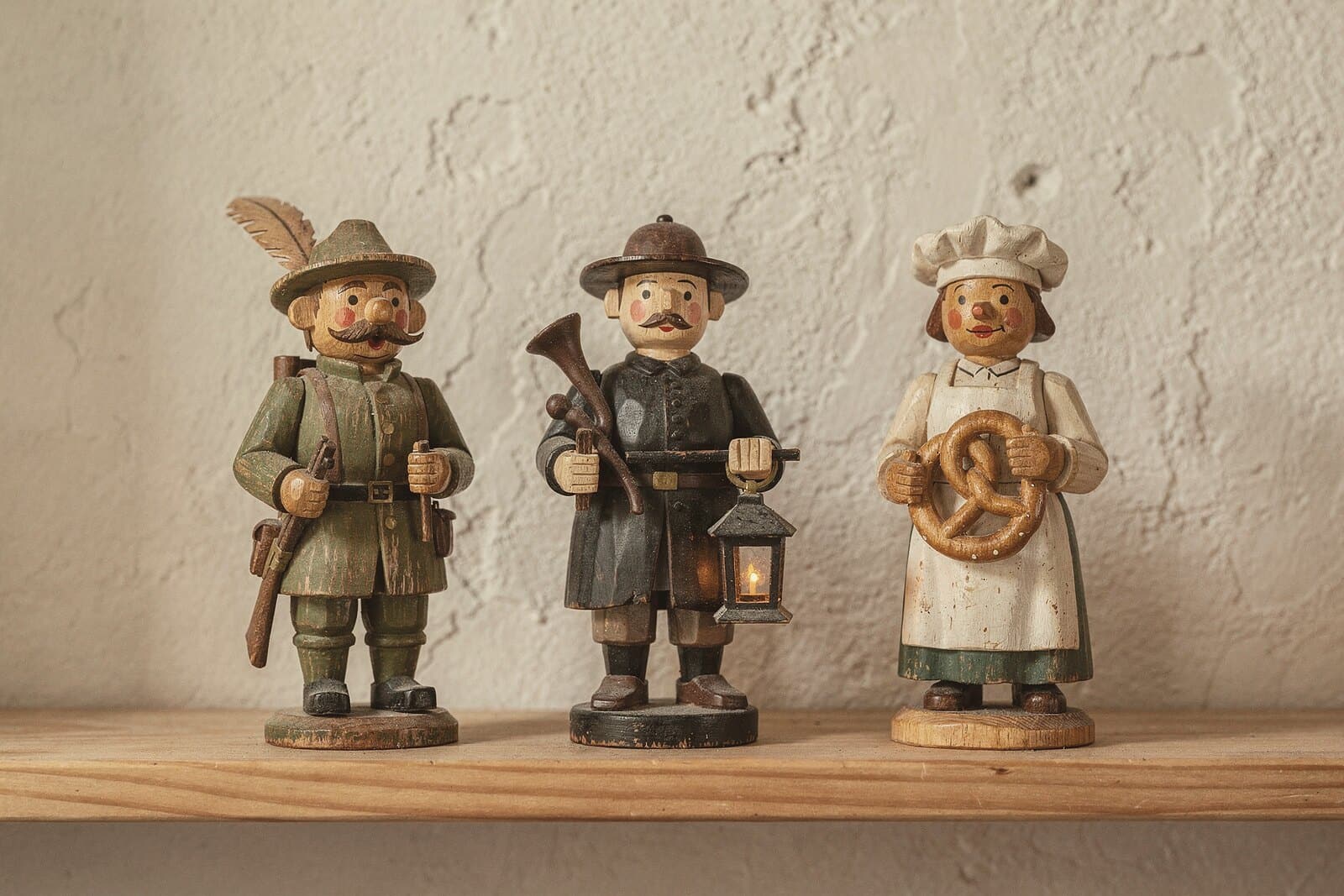
The early figures were a kindly villager with his pipe, a Turk and a Rastelbinder, a traveling tinker who mended pots with wire. Later came the people of the mountains and their trades: miners, toymakers, hunters, forest workers, peddlers and broom binders. Women were late to arrive. The first female smoker, the Kloßfrau, a woman selling dumplings, appeared only around 1930 or 1940. In the dialect of the mountains the figure is the Raachermannel, and in 1937 Erich Lang gave him a song of his own, “’s Raachermannel.”
Air the room
A cone is a small fire, and the smoke is real smoke. Germany’s Federal Environment Agency puts it plainly in its Christmas advice: “Scented and lamp oils as well as incense cones can produce pollutants when burned. So the rule here is: ventilate sufficiently.” An environmental advice center in Bremen adds that anyone who burns incense only now and then, “such as a smoker at Christmas,” need not worry; its warnings concern long, regular exposure to incense sticks.
So the ritual has a last step. Let the cone burn down on its plate, leave the smoker where it stands until the ash is cold, and open a window. The scent stays in the room a while longer. How to light a smoker, and which cone it takes
Quotations from German sources are our own translations.
Sources
- Erzgebirgisches Spielzeugmuseum Seiffen, “Weihnacht im Museum”
- Erzgebirgisches Spielzeugmuseum Seiffen, chronicle
- Gemeinde Crottendorf, “Die Entwicklung des Handwerkes seit Bestehen von Crottendorf” (2001)
- Landesfrauenrat Sachsen, Frauenorte Sachsen: Freya Graupner
- Wikipedia (German), Rauhnacht, quoting Sebastian Franck, Weltbuech (1534)
- Wikipedia (German), Räuchermann
- Umweltbundesamt, Grüne Weihnachten: Tipps für nachhaltige Feiertage
- Bremer Umwelt Beratung, Räucherstäbchen (2020)
More stories
The Bergparade: miners in their Sunday best
Every Advent, more than a thousand men and women in black parade dress march through Annaberg-Buchholz. How a royal wedding of 1719 dressed the Saxon miner, and how the parades survived to the present.
Why the miners longed for light
In midwinter, many Erzgebirge miners went down before dawn and came up after dark. What the record says about their light, and the story the mountains tell about it.
Title page of Georgius Agricola, De re metallica (Basel: Froben, 1556), public domain; scan: Mining Heritage, via Wikimedia Commons Agricola’s Book of Mines
A town doctor in a silver boomtown spent twenty-five years on the great book of mining. It was printed after his death, refused a grave in his own city, and translated into English by a future American president.