How Seiffen’s toys went out into the world
A linen trader’s wheelbarrow, merchants in the middle, crates on the Spanish silver fleet and four turners at a Dresden Christmas market. How a mountain village’s toys reached the world, and what they earned the families who made them.
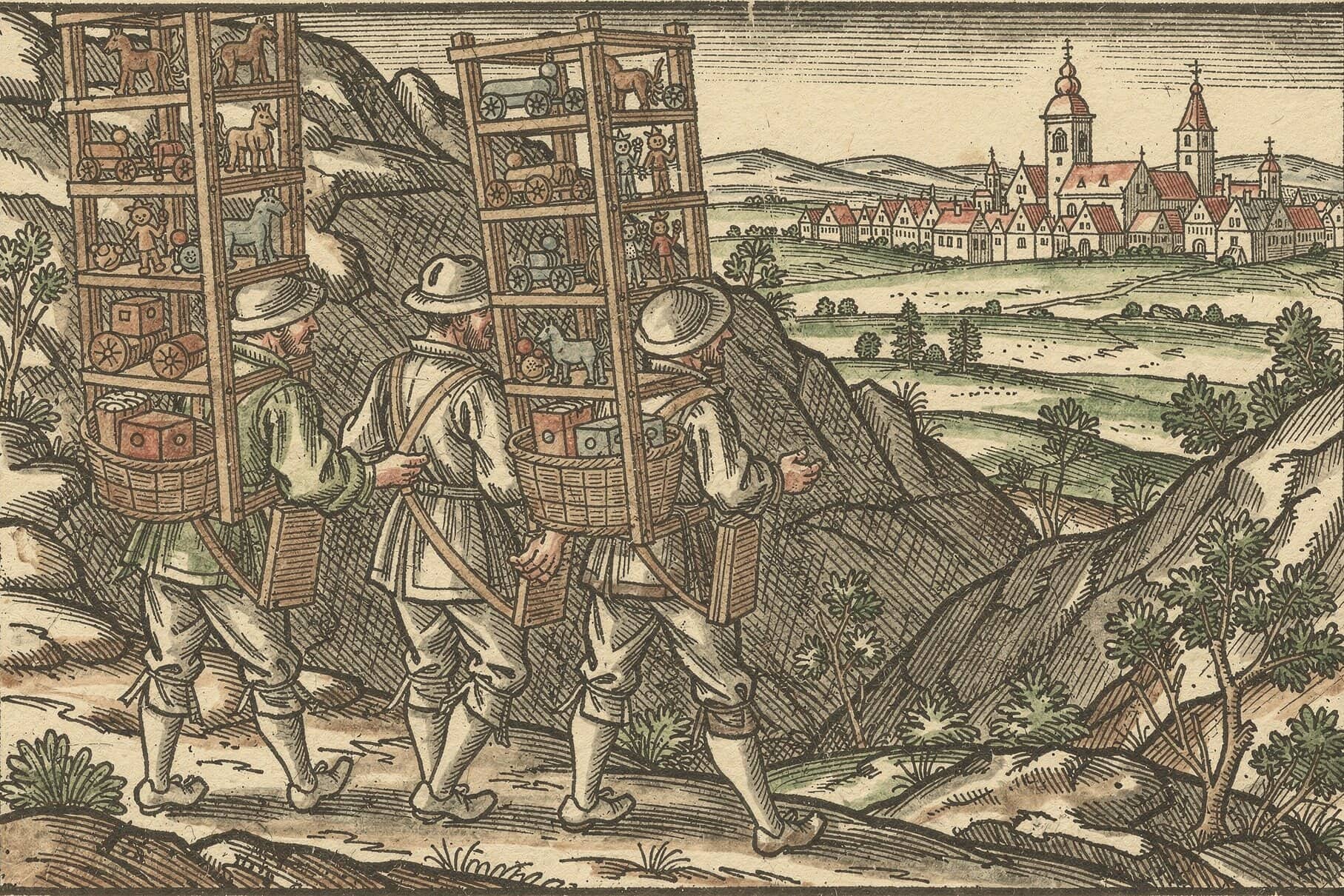
On December 13, 1836, the Dresdner Anzeiger printed a notice from the city council. At the request of the Dresden turners’ guild, it set rules for “the so-called box people from Grünhayn who come here from the mountains to sell their wooden wares at these markets.” They could sell to the public from their booths on the Neumarkt only “during the whole first day” of the Striezelmarkt, the city’s Christmas market; anyone who broke the rule faced a fine of ten thalers and exclusion from the market. One more group was named. “The four wood turners from Seyffen” were allowed to come and sell their toys, “but only in person.”
Four turners from a mountain village, named in a city ordinance and admitted on conditions: by then Seiffen’s turned ware had been going to market for generations. This is the story of how it traveled, and of who carried it.
A wheelbarrow to Leipzig
Seiffen began as a settlement of tin washers, and its people did not take up wood for pleasure. “It was not times of leisure that led the Seiffen tin miner to change his trade,” writes the village’s toy museum. “Economic need forced him to make a living from the local material, wood.” Turners are on record in Seiffen from 1650, and twenty years later there were 23 of them. Tin output peaked around 1730 and fell steeply after 1750; by then turning paid better than the failing mine, and toys were being made from about 1750.
The first trip to market, as the village tells it, came earlier still. In 1699 a linen trader named Johann Friedrich Hiemann is said to have loaded Seiffen turned ware onto his wheelbarrow beside his linen and pushed it to the Leipzig fair. He came home with orders for needle cases and wooden boxes. A study of the industry published in 1911 traced the family’s rise in the vehicles it used: “first with the carrying basket, then with a dog cart and finally with a horse cart.” In time the Seiffen merchant houses sent their goods to Leipzig and Nuremberg every fourteen days, in two large four-horse freight wagons.
Merchants in the middle
The man who turned the wheelbarrow trips into a business was the Verleger, the merchant who put work out to the households. He was the only villager who traveled for orders. He brought back the orders, and often the wood, the paint and the models too, and paid the turners each week when they delivered, sometimes in goods from his own shop instead of cash. An account of 1804 says the house of Hiemann paid out about a thousand thalers a week. Merchant houses rose in Waldkirchen and Grünhainichen around 1764, and by the early 19th century more than twenty toy villages were grouped around the merchant towns, on the Bohemian side of the mountains as well as the Saxon.
For a long time the toys left without their name. Nuremberg firms sent sample patterns, and Seiffen copied them exactly; Nuremberg merchants resold the goods, so that Seiffen, in the museum’s words, “is hardly to be found in the records.” Its products went out into the world for many years as Nürnberger Tand, Nuremberg trinkets. Letters that survive in Nuremberg, written from 1788 between Hiemann & Sohn and the firm of Förster & Günther, list what they traded: pipe cases and needle cases, “geese feeding in the stall,” “well-made stamp mills,” “riders and soldiers in lattice frames,” and yellow and red wooden apples and pears that opened to reveal tiny household goods. The museum sums up the change in two dates: an anonymous supplier of Nuremberg trinkets in 1760, a maker of Seifener Waare, Seiffen ware, traded worldwide as a quality article, by 1820.
Crates on the silver fleet
Overseas trade began in 1784. Three years later an Olbernhau merchant named Semler, protesting a rival’s request for a turning mill, set out what he had shipped: in January 1784, 25 crates worth 2,500 thalers “with the Spanish silver fleet”; in June 1785, 200 crates worth 10,000 thalers; in December 1786, 300 crates worth more than 12,600 thalers, “to various regions mostly lying outside Europe.” A Hamburg merchant ordered “12,000 needle cases several times in a row … for shipment to America,” and an account of 1804 lists Russia, Prussia, France, Spain, Portugal, “America” and the East Indies as the main markets.
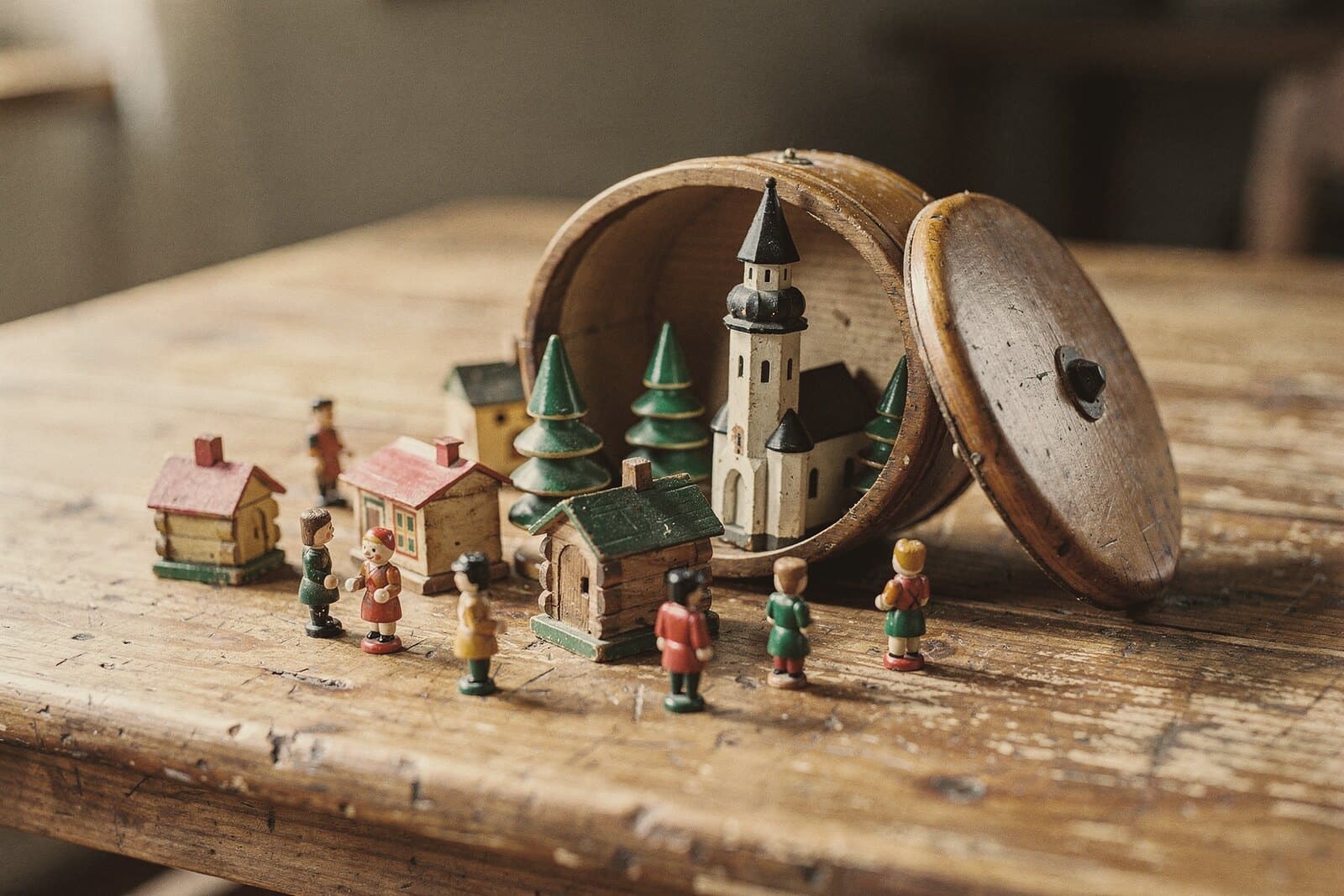
Much of it traveled boxed. Schachtelware, boxed goods, were whole assortments packed in chip boxes or little crates, among them the Noah’s ark that the museum calls an “export hit overseas.” By 1907 the United States was the biggest buyer of German toys, taking roughly 15,000 metric tons a year. How much of that came from the Erzgebirge, the author of the 1911 study admitted, “could not be obtained.” But he knew whose orders came first.
In March come the first orders of the American states, then after the Easter fair those of England.
Bernhard Westenberger, study of the Erzgebirge toy industry, 1911
The box people
Not every toy went by wagon and ship. Many were first bought up, the museum says, by traveling peddlers, who carried the goods themselves in a carrying basket, a shoulder sack or a tray, or pushed them on a handcart. Families from the mountains came down to the markets and fairs of the towns. In Dresden, by the market’s historians’ account, the box people from the Erzgebirge dominated the toy trade at the Striezelmarkt, to the annoyance of the city’s own turners’ guild, and as early as 1728 a market master went round checking the size of the baskets. Seiffen’s toymakers were at the market by 1809. That is the quarrel the council’s notice of 1836 was meant to settle.
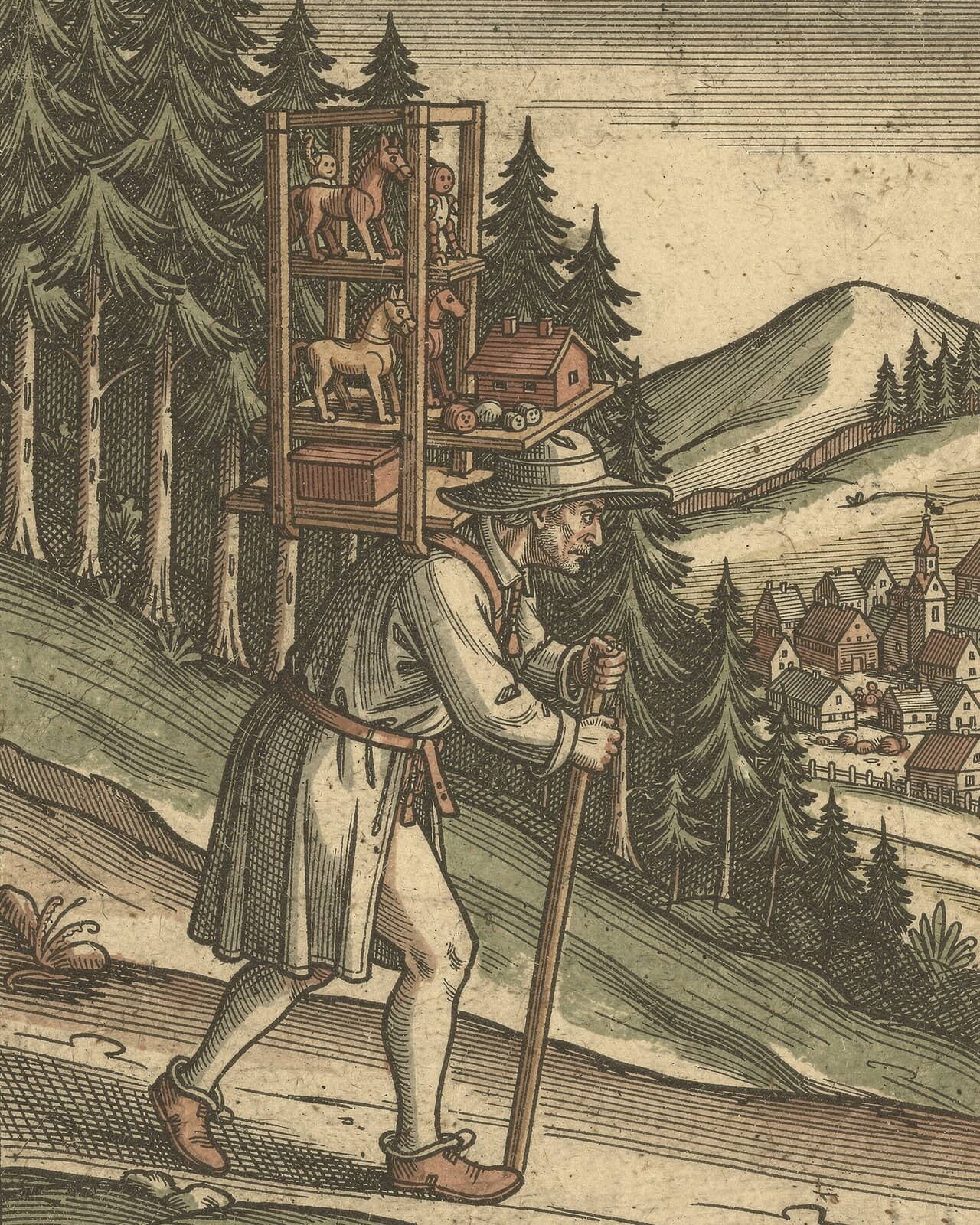
Peddling was a living in its own right in these mountains. At the end of the 19th century so many people in Satzung, a village near Marienberg, lived from it that an economist made them the subject of a study, published in 1898.
Saturday is delivery day
The 1911 study, a doctoral dissertation by Bernhard Westenberger, who went into the villages himself, shows what the trade cost the people at its root. The Verleger ordered at a price agreed beforehand, often so much a dozen. The family worked from Tuesday to Friday, starting “about 5:30 in summer, at 7 in winter,” and kept on “until 8 or 9 in the evening”; Monday went on preparing wood and buying paint. “On Saturday no work is done; instead it is ‘delivered’”: the week’s toys were carried “in large carrying baskets to the Verlegers,” and the money was paid out.
It was not much. A household earned 15 to 30 marks a week. A carver of wooden horses, working with his son, his wife and his daughter, took home 10 to 12 marks, of which about 6 went on food; the diet was “mainly potatoes, bread, coffee and oil.” In one village Westenberger found eight children sleeping in one room with five beds. Until a child-protection law of 1903, boys of ten to twelve stood at the lathes. A skilled ring turner could turn 35 to 75 rings a day, enough to keep eight to ten carving families busy with the little ring-turned animals that filled the boxes. Westenberger’s verdict on the incomes: “by no means gratifying.”
The makers had said as much long before. In 1843, 158 turners and toymakers petitioned the manorial court at Purschenstein. Fine work, they wrote, took time and labor that only a properly paid order could repay; the ordinary worker had to match the prices of “the cut-rate goods of half-trained bunglers … if he does not want to starve with his family.”
Answering with skill
The answer, when it came, was training. Saxony opened a state toy school in Seiffen on May 17, 1852, with eleven pupils. It nearly failed: some toymakers saw no need for it, the merchants were, the files say, “not well disposed toward the institution,” and the pastor blamed “the poverty of the local tradespeople.” Within five years it had almost no pupils left. Rebuilt after 1870, it had taught 967 pupils by 1904.
Tariffs forced the next change. In 1881 France replaced its duty on value with one charged by weight, 60 francs per 100 kilograms, and bulky wooden toys priced themselves out; by 1884 exports to France had fallen by about half. After 1905 one Seiffen merchant answered with miniatures in “Nuremberg scale”: tiny figures, houses and vehicles, and whole toy sets packed in a matchbox. On the eve of the First World War, about fifty towns and villages belonged to the Erzgebirge’s toy country, with more than 1,100 businesses. In 1937 the figures of the Kurrende carol singers and the Striezelkinder, the children of Dresden’s Christmas market, designed at the Seiffen school by Max Schanz, won a gold medal at the world exhibition in Paris.
Seiffen’s work no longer travels under another city’s name. About a fifth of what the region’s woodcraft workshops make is exported today, and the most important market abroad is the United States and Canada, where, a century ago, each season’s first orders came from.
Quotations from German sources are our own translations.
Sources
- Dresdner Anzeiger, December 13, 1836, notice of the Dresden city council (Wikisource)
- Erzgebirgisches Spielzeugmuseum Seiffen, Konrad Auerbach, “Entstehung der erzgebirgischen Spielzeugherstellung” (2018)
- Erzgebirgisches Spielzeugmuseum Seiffen, chronicle
- Erzgebirgisches Spielzeugmuseum Seiffen, Konrad Auerbach, “Zur Entwicklung der Spielwarenschule Seiffen” (1995, rev. 2018)
- Bernhard Westenberger, Die Holzspielwarenindustrie im sächsischen Erzgebirge (Leipzig, 1911), Internet Archive
- Kurort Seiffen, local history: the Seiffen Verleger
- Helmut Schwarz, “Spielzeug aus dem sächsischen Erzgebirge,” Spirit of Play (2017)
- Saxon State Ministry for Economic Affairs, press release (August 17, 2022)
More stories
Of smoke and incense cones
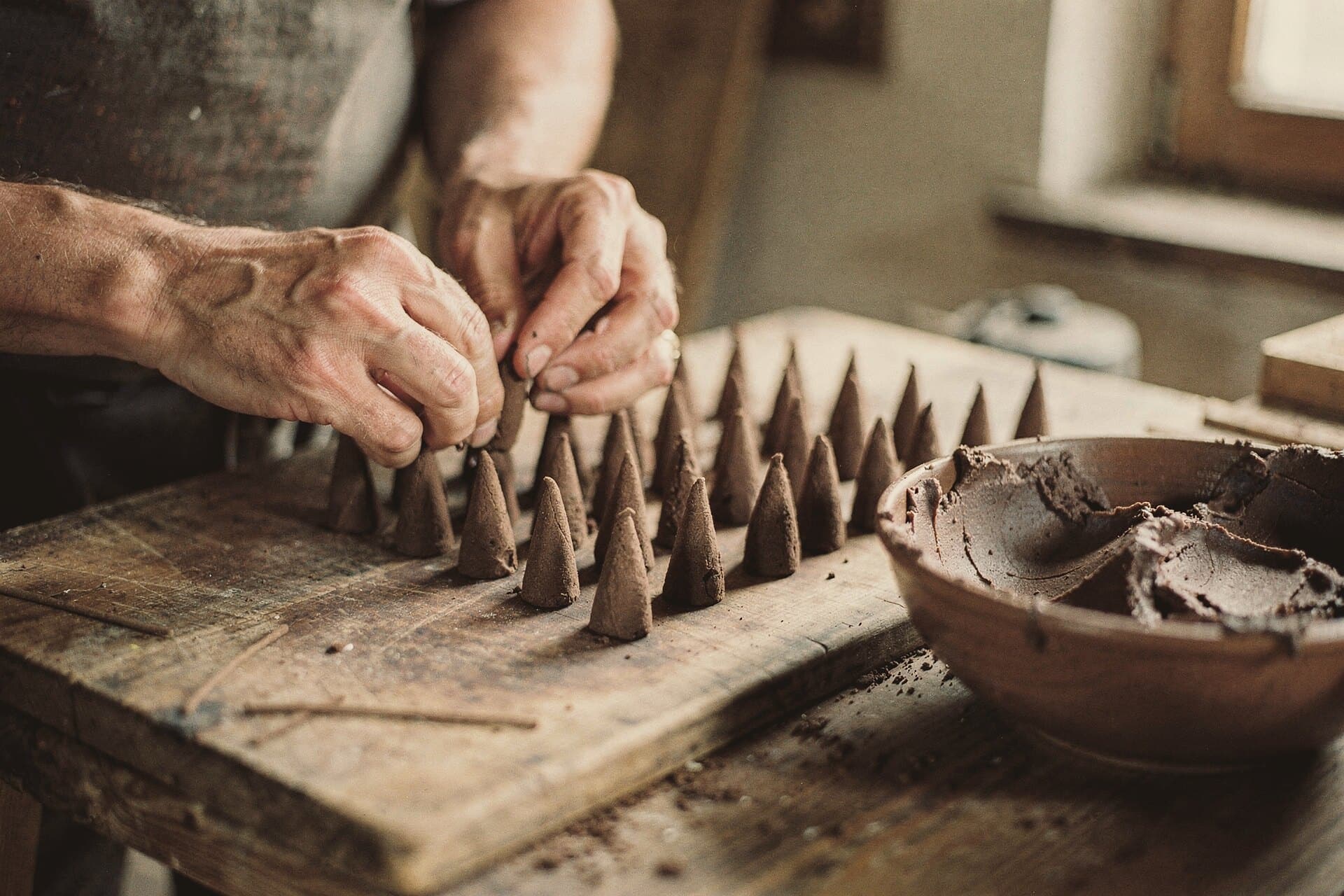
Frankincense against the spirits of the twelve nights, a dough of charcoal and beech flour, a kitchen in Crottendorf and a turner’s idea about pipes. The story of the smoker and the little cone that makes him smoke.
The Bergparade: miners in their Sunday best
Every Advent, more than a thousand men and women in black parade dress march through Annaberg-Buchholz. How a royal wedding of 1719 dressed the Saxon miner, and how the parades survived to the present.
Why the miners longed for light
In midwinter, many Erzgebirge miners went down before dawn and came up after dark. What the record says about their light, and the story the mountains tell about it.